
Over the past year, one question has come up repeatedly from founders and product leaders across Southeast Asia, Singapore, and Australia:
“We know we need AI. But who exactly should we hire?”
Some companies hire an ML engineer when they actually need an LLM engineer. Others recruit a data scientist for what turns out to be an MLOps problem. The result is months of wasted time, not because the engineers are unqualified, but because the role was defined incorrectly.
This guide solves that problem first, then covers skills, cost, process, and where to find vetted talent.
Key Takeaways
– “AI developer” is not a single role — it spans ML engineers, LLM/GenAI engineers, Agentic AI developers, NLP engineers, – computer vision engineers, data scientists, and MLOps engineers.
– The most common hiring mistake is choosing the wrong role, not hiring the wrong person.
– Cost range: $25–65/hr from Southeast Asia vs. $110–250/hr in the US, depending on specialization.
– Fastest path: pre-vetted talent marketplace — shortlist in 5–7 days, onboard in 2–3 weeks
Table of Contents
1. What Is an AI Developer?
An AI developer is a software engineer who designs, builds, and deploys artificial intelligence systems, including machine learning models, LLM-powered applications, autonomous agents, and computer vision pipelines. The term covers multiple distinct specializations, each suited to different use cases.
| Role | What They Build | Core Stack |
|---|---|---|
| Machine Learning Engineer | Predictive models, classification, recommendation systems | Python, PyTorch, TensorFlow, scikit-learn |
| LLM / GenAI Engineer | Chatbots, AI copilots, RAG systems, prompt pipelines | OpenAI API, LangChain, LlamaIndex, vector DBs |
| Agentic AI Developer | Autonomous agents, multi-agent workflows, tool-using LLM systems | LangGraph, AutoGen, CrewAI, MCP, function calling |
| NLP Engineer | Semantic search, text classification, document processing | Hugging Face, BERT, spaCy, GPT embeddings |
| Computer Vision Engineer | Image recognition, object detection, video analytics, OCR | OpenCV, YOLO, ONNX, Ultralytics |
| Data Scientist | Statistical modeling, experimentation, business analytics | Python, R, Pandas, SQL, A/B testing |
| MLOps Engineer | Model deployment, monitoring, CI/CD for ML | Docker, Kubernetes, MLflow, AWS SageMaker |
Emerging roles to know: RAG Engineer, Prompt Engineer, AI Automation Engineer, AI Integration Developer, AI Product Engineer – these increasingly appear as distinct job titles as the field matures.
2. Which AI Role Does Your Business Actually Need?
Use this decision framework before you write a single job description to hire AI Developers:
Answer one question to find the right dedicated AI developer for your use case.
The AIMS Framework — use this to structure every AI developers hiring decision:
- Assess the business problem before selecting a role
- Identify the specific AI role that maps to the use case
- Measure production experience, not just research ability
- Scale with MLOps from the start, not as an afterthought
Check out our article: How SMEs Use AI: Practical Use Cases, Benefits & Easy Guide in 2026
3. When NOT to Hire AI Developers
This is the section most hiring guides skip when hiring AI developers, and it matters.
Do not hire AI developers if:
- You’re still validating whether AI solves the problem. Discovery is a different engagement from development. Hiring a senior AI engineer for idea validation is expensive and misaligned.
- A workflow automation tool already meets your needs. Zapier, Make, or a simple API integration often does 80% of what founders assume requires an AI engineer.
- Your data quality is poor. Models trained on incomplete or inconsistent data produce unreliable outputs — no engineer can fix a data problem by writing better code.
- You don’t have access to production data. Without real data, AI development is guesswork. Prototypes that work on sample data frequently fail in production.
- The ROI is still unclear. If you can’t articulate what success looks like in measurable terms, the project isn’t ready for an AI engineer — it’s ready for a business analyst.
4. Key Skills to Look For in an AI Developer
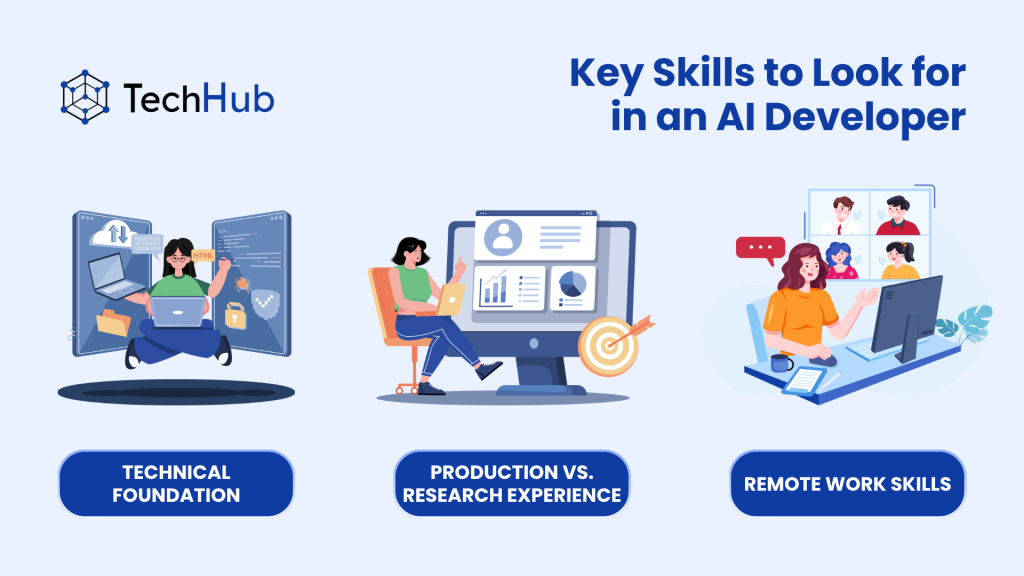
Technical Foundation
- Python proficiency — the dominant AI language; assess code quality, not syntax knowledge
- ML frameworks — PyTorch, TensorFlow, scikit-learn (role-dependent)
- LLM ecosystem — OpenAI API, Anthropic API, LangChain, LlamaIndex, vector databases (Pinecone, Chroma, Weaviate)
- MLOps tools — MLflow, Weights & Biases, Docker, Kubernetes, CI/CD for ML
- Cloud AI services — AWS SageMaker, Google Vertex AI, Azure ML, Bedrock
Production vs. Research Experience
There is a critical difference between an AI developer who can build models in a Jupyter notebook and one who can deploy, monitor, and maintain them in production. Always ask for examples of production AI systems — deployed applications with real users, not research demos or Kaggle notebooks.
Production AI engineers understand: deployment pipelines, inference optimization, guardrails, evaluation frameworks, model versioning, and monitoring for drift and hallucination.
Remote Work Skills
- Written async communication (clear Slack/PR updates, minimal need for synchronous calls)
- Ability to explain model performance and trade-offs to non-technical stakeholders
- Intellectual honesty about what AI can and cannot do for a given use case
Related Article: How To Hire An AI Builder Or AI Software Developer To Build Smart Solutions
5. How Much Does It Cost to Hire an AI Developer in 2026?
| AI Role | US / Canada | Eastern Europe | Vietnam / SE Asia |
|---|---|---|---|
| Machine Learning Engineer | $120–180/hr | $50–80/hr | $30–55/hr |
| LLM / GenAI Engineer | $150–220/hr | $60–100/hr | $35–65/hr |
| Agentic AI Developer | $140–200/hr | $55–90/hr | $35–60/hr |
| NLP Engineer | $110–170/hr | $45–75/hr | $28–50/hr |
| Computer Vision Engineer | $120–190/hr | $50–85/hr | $30–55/hr |
| MLOps Engineer | $110–180/hr | $45–80/hr | $28–50/hr |
LLM/GenAI and Agentic AI specialists command the highest premiums — demand has outpaced supply since GPT-4 launched. Production MLOps experience adds 20–30% above standard rates.
Beyond hourly rates: the real cost of running AI
Hiring AI developers is often less expensive than running the AI infrastructure itself. Budget for:
- GPU compute — training and fine-tuning runs can cost hundreds to thousands per run
- LLM API costs — OpenAI, Anthropic, and Google charge per token at scale
- Vector database — Pinecone, Weaviate, and similar services add monthly cost
- Monitoring and evaluation — tools like Weights & Biases, LangSmith, or Helicone
- Inference infrastructure — hosting and scaling deployed models
A mid-senior AI developer from Vietnam at $40–55/hr is often the most cost-effective hire a startup can make — but factor the full infrastructure picture into your AI budget from day one.
Vietnam has become one of the most cost-effective locations for hiring AI developers, particularly for companies in Singapore and Australia seeking strong engineering quality at competitive rates.
6. How to Hire AI Developers: Step-by-Step
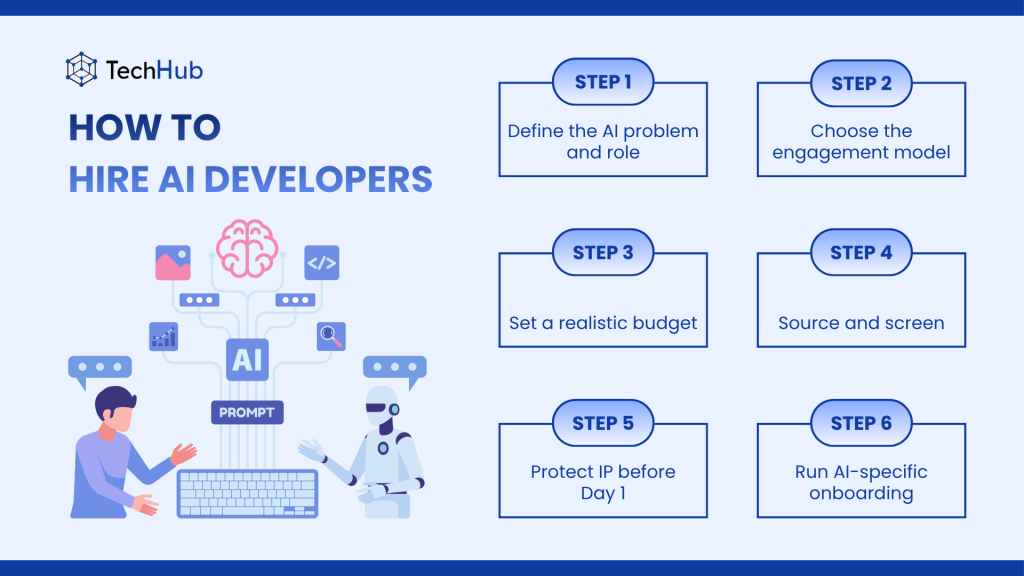
Step 1: Define the AI problem and role — start with the business outcome, not the technology. Use the decision framework in Section 2 before writing a job description.
Step 2: Choose the engagement model — dedicated AI developer (full-time, embedded, best for ongoing product development), staff augmentation (temporary skill gap), or project outsourcing (bounded, well-defined scope).
Step 3: Set a realistic budget — see Section 5. Underfunding AI hiring is the second most common mistake after hiring the wrong role.
Step 4: Source and screen — use a pre-vetted talent marketplace for speed, or source via LinkedIn, GitHub, Kaggle, and Hugging Face. Key screening signals: public AI work (repos, model cards, Kaggle notebooks), technical interview focused on real-world problem-solving, and a paid trial task on a realistic domain problem.
Step 5: Protect IP before Day 1 — sign NDA, MSA, and SOW before any data access or model training begins. All model weights, code, and training data must remain your intellectual property.
Step 6: Run AI-specific onboarding — provide data source access and documentation, define model performance KPIs, clarify platform decisions (fixed vs. flexible), and establish a development lifecycle from experimentation to production deployment.
Read more: Agentic AI vs AI Agents: 6 Steps To Build Strong Agentic AI
When businesses hire AI developers, the most costly mistake wasn’t in the technical assessment — it was choosing the wrong role entirely. We’ve seen companies hire a data scientist to build an AI chatbot, only to realize months later they needed an LLM engineer with production RAG experience. And startups that hired an ML engineer to “add AI” to their product when what they actually needed was an AI automation engineer connecting existing LLM APIs.
The AIMS Framework exists because we kept seeing the same pattern: the problem wasn’t the hire, it was the role definition.
7. How TechHub Asia Helps You Hire AI Developers
TechHub Asia connects international companies — US startups, Australian enterprises, Singapore-based SaaS businesses — with pre-vetted AI developers from Vietnam and Southeast Asia.
What TechHub offers:
- Specialized vetting — candidates assessed on Python proficiency, ML framework skills, LLM/GenAI knowledge, production deployment experience, and English communication
- Agentic & GenAI expertise — specialists in LangChain, LangGraph, OpenAI API, Anthropic API, RAG architectures, MCP, and vector database integration
- Fast matching — shortlist of 3–5 pre-vetted AI developers within 5–7 business days
- Full HR & compliance — payroll, contracts, tax compliance, local labor law handled by TechHub
- Flexible engagement — dedicated AI developer, staff augmentation, or BOT
AI solutions TechHub developers have built and deployed: AI chatbots and virtual assistants, RAG-powered enterprise search, predictive analytics engines, computer vision pipelines, AIOps platforms, and agentic workflow systems.
8. Frequently Asked Questions
Frequently asked questions
An AI developer is a software engineer who builds AI-powered systems — including machine learning models, LLM applications, autonomous agents, and computer vision pipelines. The term covers multiple distinct specializations; the right hire depends on your specific use case.
Rates range from $28–65/hr for mid-to-senior AI developers in Vietnam and Southeast Asia, to $110–220/hr in the US and Canada. LLM/GenAI and Agentic AI specialists command the highest premiums due to demand outpacing supply.
No. AI is a broad field with distinct specializations. An LLM engineer and an MLOps engineer have largely non-overlapping skills. For most startups, the right first hire is determined by the primary use case — a generalist AI developer may work for early prototyping but will hit limits quickly in production.
Validate first. If you’re still testing whether AI solves the problem, a developer is not your next hire. Run a proof-of-concept with existing tools (LLM APIs, automation platforms) before committing to a full engineering hire. This saves months.
For most companies: use APIs first. Fine-tuning requires clean, domain-specific training data, ML expertise, GPU compute budget, and ongoing maintenance. Prompt engineering and RAG architectures solve 80% of use cases at a fraction of the cost and complexity.
Only with strong senior oversight. Production AI requires judgment calls about model evaluation, hallucination guardrails, inference optimization, and monitoring — skills that develop with experience. A junior AI developer can contribute effectively in a supported team, but should not own production systems independently.
The most reliable channels in 2026: pre-vetted marketplaces (TechHub Asia, Toptal, Turing) for speed and quality; freelance platforms (Upwork, Kaggle community) for broader sourcing with more screening effort; and specialized communities (Hugging Face, Papers with Code) for research-oriented talent. For first-time AI hires, a pre-vetted marketplace delivers the best balance of speed, quality, and risk reduction.
Conclusion
In 2026, the ability to hire the right AI developer — not just any AI developer — is one of the most consequential talent decisions a company can make. The AI talent gap is real, the cost spread between markets is large, and the gap between a prototype and a production system is wider than most founders expect.

