
Raw data is useless without the infrastructure to process it. When you hire data engineers, you invest in a strong base for scalable analytics, get reliable machine learning pipelines and secure cloud solutions that drive business value.
This guide covers everything you need to hire data engineers — from defining the hiring strategy and assessing technical skills to running effective interviews and avoiding common hiring mistakes.
Key Takeaways
– Data engineer demand in Vietnam is projected to grow 38% year-over-year in 2026, significantly outpacing the broader IT market expansion.
– Mid-level data engineers command a median monthly salary of VND 56.9 million, establishing a concrete compensation premium over standard IT roles.
– 55.4% of employers report below-expected candidate quality in 2026, making practical coding and system design assessments essential for validating architectural capabilities.
– Enterprise data infrastructure requires engineers proficient in Python, Apache Spark, and Kafka to execute scalable ETL pipelines across leading cloud platforms.
– TechHub Asia accelerates enterprise talent acquisition by delivering shortlists of pre-vetted senior data engineers within a rapid 5-to-7 business day window.
- 1. Why Data Engineers Are Critical to Modern Businesses
- 2. Strategic Approaches to Hire Data Engineers
- 3. Essential Technical Skills to Look For
- 4. Soft Skills That Drive Team Success
- 5. How to Interview Data Engineers
- 6. Common Mistakes When You Hire Data Engineers
- 7. Start Your Data Engineering Recruitment with TechHub Asia
- 8. Conclusion
- 9. FAQ
1. Why Data Engineers Are Critical to Modern Businesses
Data engineering is the foundation of digital transformation. According to CareerLink’s 2026 Vietnam IT Market Report, demand for Data Engineers in Vietnam is projected to grow by 38% year over year, more than 3 times faster than the overall IT job market. To build a data-driven business, you must first understand who to hire.
1.1. Define Data Engineers vs. Data Scientists
| Feature | Data Engineer | Data Scientist |
| Core Definition | Builds and maintains the infrastructure, systems, and pipelines that move and clean data. | Analyzes, models, and interprets complex data to uncover insights and predict trends. |
| Primary Goal | Makes data reliable, clean, and accessible. | Makes data meaningful and actionable for business decisions. |
| Skill Focus | Software engineering, system architecture, ETL/ELT pipelines, distributed systems. | Advanced mathematics, statistics, machine learning, predictive modeling. |
| Core Tools | Python, SQL, Apache Spark, Kafka, AWS/GCP/Azure, Snowflake. | Python, R, SQL, TensorFlow, PyTorch, Jupyter Notebooks, Tableau. |
Hiring managers often mix up data engineers and data scientists. Data scientists aim to extract insights and build predictive models.
On the other hand, data engineers create robust pipelines for insights, ensure data is clean, accessible, and ready for analysis.
1.2. Why You Need to Hire Data Engineers First
Data engineers build the infrastructure that powers every analytics and AI initiative. By building reliable data pipelines and scalable infrastructure, data engineers create the foundation for accurate insights, better decision-making, and long-term business growth.
→ Read more: Choosing a Recruitment Agency for Hiring Senior Tech Talent
2. Strategic Approaches to Hire Data Engineers
In today’s competitive talent market, companies need a clear hiring strategy to attract top data engineering talent and build high-performing data teams.
2.1. Identify Your Specific Technical Requirements
Before writing the job description, audit your current data stack: list your data sources, storage, and processing patterns, then flag pain points like latency, schema drift, or data quality issues. This precision reduces friction and helps you hire data engineers who can start contributing immediately.
When outlining your needs, consider these factors:
- Business goal: what the engineer will enable (e.g., real-time analytics for product personalization)
- Core tech stack: AWS/GCP/Azure, plus tools like Spark, Kafka, Redshift/BigQuery/Synapse
- Key responsibilities: building pipelines, owning data quality, deploying platform components
- Experience level: years, plus proof points (production pipelines, cloud migrations, ETL/ELT design)
- Success metrics: pipeline reliability, data latency, measurable business impact
2.2. Balance In-House Teams with External Partners
Many companies use a hybrid approach: maintain a small core team in-house to own architecture and governance while leveraging external partners to accelerate development. This approach delivers many benefits for growing businesses:
- Speed to Market: Get access to a vetted pool of candidates to speed up hiring.
- Flexible Scalability: Scale your engineering team up or down based on current project phases.
- Niche Expertise: Hire specialized skills (e.g. cloud cost optimization or streaming architecture) only when needed, reducing long-term overhead.
It keeps your data infrastructure strong and adaptable to market changes, allowing your company to optimize operational costs and maximize data value.
→ Related Guide: Advantages of Working with Tech Employment Agencies: Complete Guide
3. Essential Technical Skills to Look For
3.1. Core Tools & Infrastructure: Python, Cloud, and Big Data
The best data engineers for hire stand out in the market through their technical expertise. Here are the core skills you should prioritize when evaluating candidates.
| Core Skill | Common Tools | Why It Matters | Screening Question |
| Programming & SQL | Python, SQL, Java, Scala | Builds data pipelines, transforms data, and manages databases. | Can they write clean Python code and optimize SQL queries? |
| Big Data Processing | Apache Spark, Kafka, Flink | Handles large amounts of data and supports real-time processing. | Have they built data pipelines for real-time or high-volume data? |
| Cloud Platforms | AWS, Google Cloud, Azure, Snowflake, BigQuery | Builds scalable data systems and manages cloud-based data warehouses. | Do they have hands-on experience with cloud data platforms? |
| Scalable Systems | Hadoop, Kubernetes, Data Partitioning | Keeps data systems reliable and performs well as data volumes grow. | How would they design a system that can handle growing workloads? |
Screening for these core competencies helps to hire data engineers that can build scalable data infrastructure, maintain data reliability, and maximize the value of enterprise data.
3.2. Architectural Thinking: ETL/ELT & Governance Capabilities
3.2.1. Building Scalable ETL and ELT Pipelines
Data architecture is the blueprint of your information flow. Without scalable pipelines, even the best business intelligence tools will display outdated or incorrect metrics.
Modern data engineering relies on two primary pipeline methodologies:
| Feature | ETL (Extract, Transform, Load) | ELT (Extract, Load, Transform) |
| Processing Location | Separate staging server (before loading) | Directly inside the target Data Warehouse |
| Ideal Use Case | Highly structured, legacy on-premise data | Unstructured, massive-scale cloud data |
| Speed & Cost | Slower ingestion; higher server compute costs | Faster loading; leverages cloud data warehouse power |
“Data architecture is not just about storage; it is about creating a reliable flow that empowers every decision-maker in the organization.”
– Ram Morla, Strategic Data Leader | Industrialising AI and Analytics for Business Growth
3.2.2. Implementing Data Quality and Governance
High-performing data engineers prioritize two core standards during system design:
- Data Quality: Implementing automated testing at each pipeline stage to catch null values, schema drift, or duplicate records before they reach downstream dashboards.
- Data Governance & Privacy: Restricting access control (RBAC) to ensure sensitive business information is secure and compliant with data privacy regulations like GDPR or CCPA.
By prioritizing these qualities, your company can reduce costly errors, protect sensitive information, and maximize the value of their data assets.
4. Soft Skills That Drive Team Success
“The ability to listen and communicate effectively is just as important as the ability to write clean, efficient code in a modern data-driven enterprise.”
– Ashraf Kanyadakam, Data Engineering | Data Architect | Big Data | Cloudera | Data Management ( CDMP® )
The best data engineers combine technical expertise with strong soft skills to turn complex data into meaningful business value. When companies hire data engineers, they also need to pay close attention to these essential behavioral traits.
- Business-to-Tech Communication: Great data engineers explain complex technical concepts in simple terms and align data solutions with business goals.
- Agile Problem-Solving: Look for candidates who adapt quickly to changing data requirements and resolve technical challenges efficiently.
Ultimately, the best candidates balance technical skills with a team-first mindset, ensuring your data infrastructure stays resilient through market changes.
→ Read more: How to Hire Dedicated Developers: A Comprehensive Guide in 2026
5. How to Interview Data Engineers
According to Vietnam’s IT Salary & Recruitment Market Report 2025-2026, 55.4% of employers find the quality of job candidates is lower than expected, making the competition to hire skilled data engineers increasingly fierce. An effective interview process is structured to evaluate whether data engineer candidates have the skills and experience to meet your business needs.
5.1. Designing Practical Coding Assessments
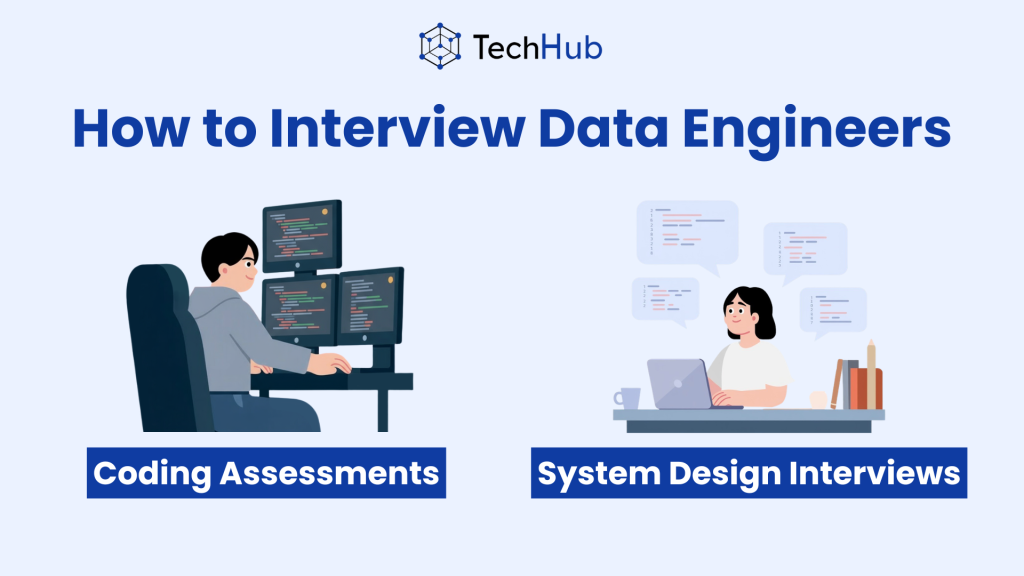
Practical coding tests should reflect the real challenges your team faces. Instead of abstract puzzles, give candidates hands-on data tasks relevant to daily work. This shows how they handle real-world data complexity and unexpected issues.
To make a good test, focus on these key points:
- Data Cleansing: Ask candidates to handle unstructured, missing or corrupt data files.
- Query Optimization: Give them a poorly written SQL query. Can they analyze the inefficiency and optimize it to improve processing speed?
- Code Quality: Look at their ability to write clean, modular, and documented code.
5.2. Conducting Effective System Design Interviews
System design interviews test a candidate’s architectural thinking. You should focus on the reasoning behind their technical decisions by presenting a real scalability challenge your company faced and evaluate their decision-making:
- Constraint Gathering: See how they clarify constraints and goals before suggesting a solution.
- Trade-off Analysis: Can they logically justify their architectural choices, explaining why they prefer one storage or processing model over another for a specific workload?
- Scalability Planning: Ask how their design handles sudden traffic spikes and unexpected system downtime to see if they can build robust pipelines that scale seamlessly under pressure.
These interview stages give you a clearer view of how candidates think, solve real data challenges with practical, scalable solutions.
→ Related Guide: Top 50+ Interview Questions for Mid-level Engineering
6. Common Mistakes When You Hire Data Engineers
Many companies invest significant time and resources to hire data engineers but still struggle to achieve the expected results. In most cases, it’s common hiring mistakes that companies tend to overlook. Avoiding these avoidable pitfalls will save your company months of wasted onboarding time, high turnover costs and help find the right data engineers for your team.
6.1. Hiring Based Only on Academic Certifications
A strong degree doesn’t always translate into strong performance. Prioritize candidates with hands-on experience building production data pipelines, cloud infrastructure, or open-source projects over academic achievements alone.
6.2. Ignoring Business Context
Technical skills matter, but data engineers also need to understand business objectives. Candidates who focus only on technology without considering business impact may build overly complex solutions that increase costs without delivering value.
6.3. Expecting One Engineer to Do Everything
Avoid hiring a single data engineer to handle data architecture, pipeline development, analytics, governance, and infrastructure. Define the role clearly and hire for the skills your team needs most.
6.4. Hiring Only for Your Current Tech Stack
Choosing candidates solely because they know your existing tools can limit future growth. Look for engineers with strong fundamentals and the ability to learn new technologies as your data platform evolves.
7. Start Your Data Engineering Recruitment with TechHub Asia
TechHub Asia helps global companies hire pre-vetted data engineers from Vietnam and Southeast Asia without the complexity of traditional recruitment.
What TechHub Asia offers:
- Pre-vetted data engineers — assessed for SQL, Python, ETL/ELT, cloud platforms (AWS, Azure, GCP), Spark, Airflow, data warehousing, and English communication
- Fast hiring — receive a shortlist of qualified candidates within 5–7 business days
- Flexible engagement models — dedicated data engineers, staff augmentation, or Build-Operate-Transfer (BOT)
- Complete HR & compliance — payroll, contracts, tax, and local labor law managed by TechHub Asia
- Scalable hiring — quickly expand your data engineering team as your business and data infrastructure grow
TechHub Asia’s data engineers have experience building and maintaining: real-time ETL pipelines, cloud-native data platforms, data lakes and warehouses, streaming data systems, analytics infrastructure, and enterprise-grade data architectures that support AI and business intelligence initiatives.
8. Conclusion
Hiring data engineers is a long-term investment in your company’s data capabilities. You can build a data team that’s ready to scale with your business with TechHub Asia’s network.

