
In the era of data-driven growth, customer relationships define business success. Companies that can centralize, analyze, and act on customer data gain a decisive advantage in retention and revenue. That’s where Customer Relationship Management (CRM) systems come in — and why hiring CRM developer is no longer optional, but essential.
According to Fieldwork, implementing a CRM in 2026 drives a clear growth advantage for businesses by boosting sales revenue by 29% and increasing revenue per sales representative by 41%. But not all CRM implementations succeed — many fail due to poor customization or mismatched talent.
If you’re wondering how to hire CRM developers that deliver results, this updated 2026 guide from TechHub Asia outlines every step — from defining your needs to selecting the right CRM development company.
Key Takeaways
> Implementing a CRM system delivers strong growth advantage: 29% increase in sales revenue and 41% boost in revenue per sales rep (Fieldwork, 2026).
> As of 2026, top-tier CRM developers need more than core coding skills — proficiency in AI-powered CRM workflows, low-code automation, and DevOps practices (CI/CD, governance) is now baseline expectation.
> Businesses can choose between freelancers for quick tasks, in-house teams for continuous scaling, or CRM development companies for full-scope project delivery.
> In 2026, core CRM/ERP customization costs average of $25–$45/hour, AI-powered work like chatbot integration, workflow automation, AI agents commands $47–$333/hour, meaning AI-related CRM projects can cost up to 7x more than standard customization.
> Most CRM failures stem from unclear requirements, uncertified hires, and neglecting ongoing maintenance, which costs 10–20% of the initial budget annually.
Table of Contents
1. What Does A CRM Developer Do?
Before you decide to hire CRM developers, it’s important to understand what they actually do — and why their work directly impacts business performance.
A CRM developer is a specialized software professional responsible for tailoring CRM systems such as Salesforce, HubSpot, Microsoft Dynamics, or Zoho CRM to fit a company’s sales and customer service processes. Their goal is to transform a generic CRM into a high-performing, automated ecosystem that drives productivity and customer satisfaction.
2. Core Responsibilities of a CRM Developer
- Customization & Configuration: Designing dashboards, automating workflows, and integrating third-party applications.
- Integration with Business Systems: Connecting CRM with ERP, marketing automation, and payment platforms.
- Data Management: Ensuring data consistency, synchronization, and compliance with security standards.
- Performance Optimization: Enhancing system speed and user experience across departments.
3. Essential Skills and Tech Stack of a CRM Developer
A top-tier CRM developer for hire should possess strong knowledge of APIs, JavaScript, SQL, Python, C#, or Apex (for Salesforce). They must be proficient in CRM SDKs, automation tools, and RESTful API integrations.
Beyond technical fluency, communication and problem-solving skills are vital — your developer will often act as a bridge between technical teams and business stakeholders.
As of 2026, a top-tier CRM developer is expected to combine strong skills in APIs, JavaScript, SQL, and a backend language (Python, C#, or Salesforce Apex) with hands-on experience in CRM SDKs, low-code automation, secure REST/GraphQL integrations, AI-powered CRM workflows, and modern DevOps practices such as CI/CD, observability, and governance.
For a deeper breakdown of CRM developer skills, certifications, and career paths, check out: How to Become a CRM Developer: Simplified Blog Structure
4. Step-by-Step Guide on How to Hire CRM Developer
Hiring a CRM developer is about finding a strategic partner who can customize your CRM to your business goals. Follow these five key steps to ensure you choose the right expert and maximize your investment.
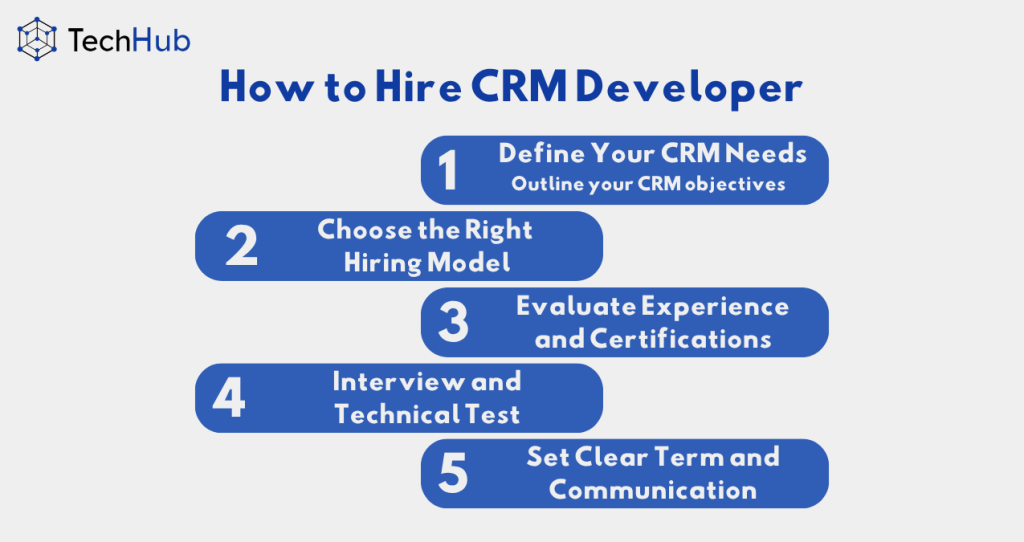
4.1. Define Your CRM Needs
Before searching for candidates, outline your CRM objectives clearly.
- Which platform are you using — Salesforce, HubSpot, Microsoft Dynamics or Zoho?
- Do you need custom dashboards, automated lead scoring, or full API integration with marketing tools?
Understanding your priorities will help you define a detailed job scope and avoid hiring the wrong specialist.
4.2. Choose the Right Hiring Model
When planning to hire CRM developer for your business, it’s important to choose the right hiring model that fits your goals and budget. There’s no single approach as the best method depends on how much control and flexibility you need, but three primary options stand out:
- Freelancers: Ideal for short-term customization, quick integrations, or small automation tasks. Independent contractors work well for small-scale projects or initial trial runs.
- In-house Team: Best if you plan to scale your system continuously and need full-time maintenance. This approach ensures direct communication, tight alignment with your company culture, and faster iteration cycles.
- Partner with a CRM development company when you need end-to-end delivery – from initial design to final deployment. It gives you immediate access to experienced talent, multi-platform expertise, and built-in quality control without the overhead of internal recruiting.
For many growing businesses, outsourcing to a trusted agency offers the fastest route to launch while maintaining high quality and flexibility.
👉 Read more: How to Hire Remote Developers
4.3. Evaluate Experience and Certifications
When reviewing candidates or agencies, look for proven experience with CRM platforms relevant to your business. Essential certifications include:
- Salesforce Certified Developer / Administrator
- HubSpot Developer Certification
- Microsoft Dynamics 365 Specialist
Ask for client portfolios or demo projects. The right developer should not only understand CRM architecture but also have experience aligning technology with marketing and sales strategies.
4.4. Interview and Technical Test
A structured interview process is essential when you plan to screen for CRM developer candidates who can deliver both technical accuracy and business impact. Instead of relying on resumes alone, design an evaluation flow that tests real-world expertise.
During the interview, focus on questions that reveal depth, adaptability, and hands-on experience:
- CRM Integration & Data Migration: Ask about past projects involving system integrations, data migration strategies, and how they ensured data consistency and accuracy.
- Problem-Solving & Automation: Explore their approach to automating customer journeys, creating workflows, and managing CRM triggers for marketing or sales pipelines.
- Security & Compliance Practices: Discuss how they handle sensitive customer information, comply with GDPR or similar standards, and ensure secure API communications.
Finally, always include a short, practical test project or coding exercise. A real-world scenario — such as customizing a CRM dashboard or integrating a mock API — will help you objectively assess the candidate’s code quality, communication, and delivery approach.
👉 Read more: Top 50+ Mid-Level Engineering Interview Questions
4.5. Set Clear Terms and Communication
Once you’ve selected your CRM expert, define the collaboration structure:
- Scope of work, timeline, and KPIs
- Reporting frequency and communication tools (Slack, Asana, Jira)
- Ownership of code and post-deployment support terms
Setting expectations upfront ensures accountability and transparency — the foundation of a successful partnership.
5. Cost to Hire CRM Developers
Understanding the cost structure helps you make informed decisions and set realistic expectations. The pricing depends on several factors — from location and skill level to project scope and engagement model.
5.1. CRM Developer Pricing Benchmarks in 2026
As of 2026, the cost of hiring CRM developers depends not only on experience but also on the complexity of the work involved. Based on 2026 Fiverr marketplace data, from standard CRM customization to AI-powered automation, the table below outlines the typical pricing ranges for different CRM development services.
| CRM Service Category | Typical Hourly Rate (USD) | Typical Fixed Project Price (USD) | Notes |
|---|---|---|---|
| Core CRM & ERP Development | $25–$45 | $150–$307 | CRM customization, module development, implementation |
| AI Chatbot Integration | $47–$270 | $216–$300 | AI assistants, chatbot integration, conversational CRM |
| API & CRM Integrations | $10–$315 | $70–$199 | Third-party APIs, system integrations, middleware |
| Database Development & Optimization | $40–$75 | $134–$155 | Database design, optimization, CRM data architecture |
| CRM Management & Administration | $47–$150 | $117–$134 | CRM configuration, maintenance, ongoing administration |
| Workflow Automation & AI Agent Development | $48–$333 | ~$152 | CRM workflow automation, AI agents, process automation |
| AI Integration for CRM | $10–$80 | ~$298 | AI feature integration, predictive analytics, AI-powered CRM capabilities |
Overall, standard CRM development services typically range from $25–$45 per hour, while highly specialized work involving AI, workflow automation, or enterprise integrations can exceed $300 per hour. This wide pricing range reflects differences in project complexity, required platform expertise, and the level of technical specialization needed to deliver the solution.
For companies planning to hire CRM developers, these benchmarks can help set realistic budgets based on project scope.
5.2. Key Cost Drivers
- Project Scope & Complexity: The number of integrations, automations, and third-party systems directly affects cost. Complex Salesforce or Microsoft Dynamics customization typically requires senior-level developers.
- Experience & Certification
Certified developers (e.g., Salesforce Certified, HubSpot Developer) may charge more — but their efficiency reduces long-term costs. - Engagement Model
- Freelancers: Flexible but less reliable for complex systems.
- Dedicated Developers: Cost-effective for medium to large projects.
- CRM Development Company: Offers scalability, project management, and guaranteed quality.
Post-Deployment Support: Ongoing CRM maintenance, upgrades, and analytics often cost around 10–20% of the initial project value annually.
Because project complexity, onboarding time, and delivery risks all affect the total cost of ownership, many companies choose to work with specialized CRM development partners instead of hiring individual freelancers. This approach can improve delivery speed while providing access to complementary roles such as business analysts, project managers, CRM specialists and so on.
Read more: How to Hire the Right Zoho Developer For Your Business Needs
6. Common Mistakes When Hiring CRM Developer
Even the most forward-thinking companies can make costly errors when hiring CRM specialists. Understanding these pitfalls in advance helps you save time, budget, and resources — while ensuring your CRM project succeeds from day one.
Here are the most common mistakes businesses make when trying to hire CRM developers, and how to avoid them:

6.1. Not Defining Business Requirements Clearly
Many projects fail before they even begin because the business doesn’t outline its CRM goals.
Without clarity on workflows, automation needs, or reporting requirements, developers can only guess what’s needed — leading to rework and frustration.
Solution: Always document your CRM objectives, KPIs, and integration needs before recruitment.
6.2. Hiring Based Only on Technical Skills
Technical skills are essential, but they’re not enough. A great CRM developer must also understand sales processes, marketing funnels, and customer lifecycles.
Solution: During interviews, ask scenario-based questions that assess business logic, not just coding ability.
- “How would you ensure data integrity in opportunity stages without hurting the sales rep’s user experience?”
- “Sales reps are recycling old closed/lost leads instead of creating new ones; how would you solve this technically to protect reporting accuracy?”
6.3. Ignoring Platform-Specific Expertise
Each CRM platform (Salesforce, HubSpot, Zoho, Dynamics) has its own architecture and certification paths. Hiring a developer without proven experience in your chosen platform can cause compatibility or scalability issues.
Solution: Always verify certifications and past project portfolios.
6.4. Overlooking Data Security and Compliance
CRM systems hold sensitive customer data. Failing to ensure your developer follows global compliance standards (GDPR, HIPAA, ISO) can lead to severe legal consequences.
Solution: Choose developers or agencies with strong data security credentials and proven compliance frameworks.
6.5. Choosing the Wrong Hiring Model
Businesses often underestimate the importance of selecting the right hiring approach — freelancer, full-time, or CRM development company.
Hiring freelancers may seem cheaper initially but can cause delays, inconsistent quality, or lack of accountability.
Solution: Work with a trusted partner who offers scalable CRM development services with guaranteed delivery and support.
👉 Read more: How To Hire Developers in Vietnam: Legal, Practical, and Strategic Insights
6.6. Neglecting Post-Launch Support
Many businesses treat CRM deployment as a one-time project instead of a continuous process. Without ongoing updates, bug fixes, and optimization, even the best CRM will lose value over time.
Solution: Partner with an agency that provides ongoing support, analytics, and system scalability.
7. Where to Hire CRM Developer
With your scope and budget defined, you can focus on finding the right people. The real challenge usually isn’t finding talent, but bringing on developers who actually fit your technical needs and company culture. Here are 5 recommended channels to consider:
7.1. Freelance Platforms
Websites like Upwork, Freelancer, and Toptal provide access to thousands of independent CRM developers worldwide. However, the quality and reliability vary greatly — freelancers often juggle multiple projects, which can lead to missed deadlines or inconsistent performance.
✅ Best For: Short-term or low-complexity CRM customization tasks.
❌ Risk: Limited accountability and post-deployment support.
7.2. Professional Networks
LinkedIn and GitHub are excellent platforms to discover experienced CRM professionals with verified certifications and proven technical portfolios.
By reviewing client endorsements and repositories, you can identify candidates who meet your project’s exact needs.
✅ Best For: Building direct relationships with potential hires.
❌ Risk: Requires time-consuming vetting, interviews, and onboarding.
7.3. Specialized CRM Development Companies
For mid to large-scale projects, partnering with a CRM development company ensures high-quality results, scalability, and accountability from day one. These agencies provide complete CRM expertise — from consultation and system customization to long-term support.
7.4. Regional Tech Hubs (Vietnam, Singapore, and Beyond)
Asia — particularly Vietnam — has emerged as one of the most reliable destinations for offshore CRM development. CRM developer rates in Vietnam typically run $20–$50/hour, compared to $80–$160/hour in Western Europe and North America. Vietnam’s strong English proficiency, time-zone alignment, and tech talent pool make it an ideal hub for international partnerships.
7.5. Referral Networks and Industry Partnerships
Word-of-mouth and professional networks remain underrated but powerful hiring tools. Ask your partners, industry peers, or SaaS vendors for referrals — a trusted recommendation often leads to a reliable, long-term partnership.
Read more: How Much Does It Cost to Hire Zoho Developers in 2026?
Conclusion
Hiring the right CRM developer requires defining your business needs, evaluating technical and business expertise, choosing the best hiring model, understanding costs, and avoiding common mistakes to ensure a successful, high-ROI CRM implementation.
As an experienced CRM development company, TechHub Asia helps businesses hire certified experts in Salesforce, HubSpot, and Microsoft Dynamics. Whether you need custom development, system migration, or IT staffing, we deliver scalable solutions built for long-term success.

