
Artificial Intelligence (AI) is no longer reserved for large enterprises. Today, small and medium-sized enterprises (SMEs) are rapidly adopting AI to improve efficiency, reduce costs, and compete in a digital-first economy.
From automation to predictive analytics, AI is transforming how SMEs operate, market, and grow. Tools like ChatGPT and Google Gemini have made AI more accessible than ever—even for businesses with limited technical resources.
This guide explores how SMEs use AI, real-world applications, benefits, and how to get started.
Key Takeaways
– Automating routine workflows boosts overall efficiency by 14% and accelerates novice employee output by an impressive 35%.
– Deploying AI chatbots cuts customer response times by 80%, while predictive recommendations drive a 20% to 30% increase in direct conversion rates.
– Utilizing accessible GenAI tools (ChatGPT, Google Gemini) slashes marketing and content production timelines by 50%.
– SMEs can completely bypass the need for expensive in-house data scientists by leveraging no-code automation platforms (Zapier, Make) to immediately resolve operational bottlenecks.
– Overcome initial cost misconceptions by adopting a strict 5-step rollout: identify bottlenecks, start small with freemium tools, train the workforce, and rigorously measure financial ROI.
Table of Contents
What Is AI for SMEs?
AI for SMEs refers to the use of artificial intelligence technologies—such as machine learning, natural language processing, and automation—to improve business processes, decision-making, and customer experiences.
👉 In simple terms:
AI helps small businesses do more with less—less time, less cost, and fewer manual processes.
Why SMEs Should Adopt AI
1. Increase productivity
A 2023 study by the National Bureau of Economic Research shows that AI boosts productivity by 14% on average—and up to 35% for novice workers—by streamlining routine workflows.
AI automates repetitive tasks like:
- data entry
- customer responses
- reporting
👉 Result: employees focus on higher-value work.
2. Reduce operational costs
Instead of hiring large teams, SMEs can:
- automate workflows
- optimize inventory
- reduce human error
3. Improve decision-making
AI analyzes large datasets quickly to provide:
- insights
- forecasts
- recommendations
4. Compete with larger companies
AI levels the playing field by giving SMEs access to:
- advanced analytics
- marketing automation
- personalized customer experiences
→ Read more: How to Hire AI Developers: A Complete Guide in 2026
How SMEs Use AI: Case Studies
1. Customer Service Automation
ChatGPT-powered chatbots can:
- answer FAQs 24/7
- handle customer inquiries
- reduce support workload
👉 Example: An online store uses AI chatbot → reduces response time by 80%.
2. Marketing & Content Creation
AI tools help SMEs:
- generate blog posts
- write ads
- personalize email campaigns
👉 Tools:
- ChatGPT
- Google Gemini
3. Sales Forecasting
AI analyzes historical data to:
- predict demand
- identify trends
- optimize pricing
👉 Result: Better inventory planning and reduced waste.
4. Data Analysis & Business Intelligence
AI tools can:
- process large datasets
- generate dashboards
- provide insights
👉 SMEs can make data-driven decisions without data scientists.
5. Process Automation (RPA)
AI automates repetitive workflows:
- invoice processing
- HR onboarding
- order management
6. Fraud Detection & Risk Management
AI detects:
- unusual transactions
- suspicious behavior
👉 Especially useful for fintech, e-commerce SMEs.
Real Examples of SMEs Using AI
1. E-commerce SME
- Used AI for product recommendations
- Increased conversion rate by 20–30%
2. Marketing agency
- Used AI content tools
- Reduced content production time by 50%
3. Retail business
- Used AI for demand forecasting
- Reduced inventory waste
Best AI Tools for SMEs
1. Content & Communication
- ChatGPT
- Google Gemini
2. Automation
- Zapier (workflow automation)
- Make (no-code automation)
3. Analytics
- Power BI
- Google Analytics (AI insights)
4. Customer Support
- AI chatbots
- CRM with AI features
→ Read more: Agentic AI vs AI Agents: 6 Steps To Build Strong Agentic Ai
Challenges of AI Adoption in SMEs
1. Cost concerns
Many SMEs worry AI is expensive.
👉 Reality:
- Many tools are affordable or freemium
- ROI often outweighs cost
2. Lack of expertise
SMEs often lack:
- data scientists
- AI engineers
👉 Solution:
- use no-code tools
- partner with consulting firms
3. Data limitations
AI requires data to perform well.
👉 SMEs should:
- start collecting structured data early
- integrate systems
4. Change management
Employees may resist new technology.
👉 Solution:
- training
- gradual adoption
How SMEs Can Start Using AI (Step-by-Step)
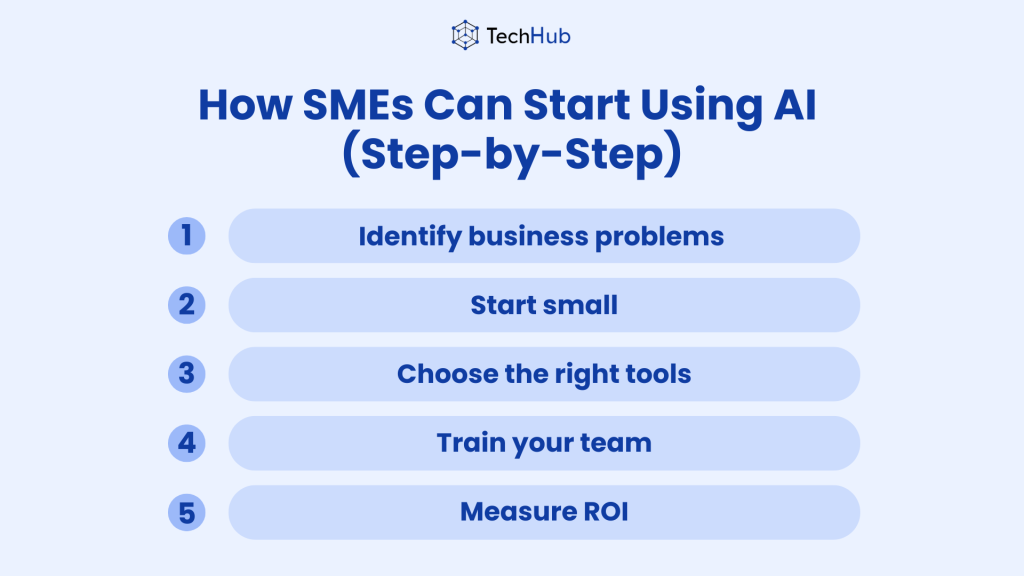
Step 1: Identify business problems
Focus on:
- repetitive tasks
- inefficiencies
- bottlenecks
Step 2: Start small
Begin with:
- chatbot
- automation
- reporting tools
Step 3: Choose the right tools
Pick tools that are:
- easy to use
- scalable
- affordable
Step 4: Train your team
Ensure employees:
- understand AI tools
- know how to use them effectively
Step 5: Measure ROI
Track:
- time saved
- cost reduction
- revenue impact
→ Read more: How To Hire An AI Builder Or AI Software Developer To Build Smart Solutions
Future of AI in SMEs
AI adoption among SMEs is expected to grow rapidly by 2026 and beyond.
Key trends:
- no-code AI tools
- AI-as-a-service
- industry-specific AI solutions
How TechHub Asia Helps You Hire AI Developers
TechHub Asia connects international companies — US startups, Australian enterprises, Singapore-based SaaS businesses — with pre-vetted AI developers from Vietnam and Southeast Asia.
What TechHub offers:
- Specialized vetting — candidates assessed on Python proficiency, ML framework skills, LLM/GenAI knowledge, production deployment experience, and English communication
- Agentic & GenAI expertise — specialists in LangChain, LangGraph, OpenAI API, Anthropic API, RAG architectures, MCP, and vector database integration
- Fast matching — shortlist of 3–5 pre-vetted AI developers within 5–7 business days
- Full HR & compliance — payroll, contracts, tax compliance, local labor law handled by TechHub
- Flexible engagement — dedicated AI developer, staff augmentation, or BOT
AI solutions TechHub developers have built and deployed: AI chatbots and virtual assistants, RAG-powered enterprise search, predictive analytics engines, computer vision pipelines, AIOps platforms, and agentic workflow systems.

