
Quick answer
To hire VR developers efficiently, first define whether the role is for gaming, enterprise training, or remote collaboration; then assess candidates on the specific game engine and hardware optimization used in that domain, not on general software experience alone. A 2026 ZipRecruiter report puts average US VR developer salaries around $109,905 per year, with the middle 50% ranging from $84,000 to $134,500, while specialist staffing partners like TechHub Asia can deploy vetted offshore talent within seven days. These figures are US employment benchmarks — not guaranteed project quotes — so request a role-specific rate that states seniority, engagement model, and what the fee includes.
To hire VR developers efficiently in 2026, define your target device and game engine first, then evaluate candidates through runnable demos, performance profiling, and a small paid technical task. Freelancers are usually best for prototypes and isolated fixes, while dedicated developers are better suited to long-term product development and integration with an existing team.
If speed is the priority, a specialist staffing partner can shorten the search. TechHub Asia provides access to a network of more than 30,000 screened candidates in Vietnam, employs over 200 engineers directly, and can onboard selected talent within seven days.
Key Takeaways
– Match the developer’s engine, device, and deployment experience to your project; “VR developer” is too broad a requirement on its own.
– For Meta Quest projects, candidates should understand standalone-device constraints and be able to maintain the application’s target refresh rate.
– Unity and C# are common for cross-platform and standalone VR; Unreal Engine and C++ are often selected for high-fidelity visualization.
In the United States, ZipRecruiter reported an average annual VR developer salary of $109,905 as of 2026.
– A portfolio review should establish what the candidate personally built, how the application performed on target hardware, and how they diagnosed bottlenecks.
– Choose a freelancer for a narrow, short-term task; choose a dedicated developer for sustained delivery; choose an in-house employee when permanent ownership and long-term organizational knowledge are the priorities.
Table of Contents
1. What Does a VR Developer Do?
A VR developer is a software engineer who designs, programs, and optimizes immersive, three-dimensional applications for virtual reality headsets. They connect 3D assets, interaction design, device inputs, and application logic to create an experience that feels responsive and comfortable to use.
Typical responsibilities include:
- Programming interactions: Building object grabbing, locomotion, spatial menus, hand tracking, and controller input.
- Engine architecture: Structuring the project in Unity or Unreal Engine and selecting suitable plugins, packages, and rendering pipelines.
- Performance optimization: Reducing draw calls, tuning shaders and lighting, managing memory, and maintaining the target frame rate on the intended device.
- Hardware and SDK integration: Connecting the application to headsets, controllers, sensors, and platform-specific software development kits.
- Testing and debugging: Diagnosing rendering issues, interaction errors, tracking problems, spatial-audio defects, and device-specific failures.
- Team collaboration: Working with 3D artists, UX designers, backend engineers, QA specialists, and product managers.
The role changes with the product. A VR game developer focuses on gameplay systems, AI behavior, level design, and player engagement. An enterprise VR application developer may focus more on accurate simulations, data visualization, training workflows, security, and integration with business systems. VR developers build the software; VR technicians typically install, maintain, and troubleshoot the physical equipment.
2. Why Businesses Hire VR Developers
Businesses hire VR developers when an immersive, spatial experience can solve a problem that is difficult, risky, or expensive to reproduce in the physical world. Common applications include:
2.1. Training and Simulation
Aviation, manufacturing, defense, and healthcare organizations use VR to let people practice procedures in controlled environments. The business value comes from repeatable scenarios, safe experimentation, and the ability to rehearse before using real equipment or working with real patients.
2.2. Education and E-Learning
VR learning modules allow students and employees to explore 3D concepts, practice tasks, and interact with environments that would otherwise be inaccessible. When assessing an education project, define the intended learning outcome rather than assuming immersion alone will improve results.
2.3. Architecture, Engineering, and Construction
Architects and real estate teams can turn CAD or BIM assets into explorable environments. Stakeholders can review scale, sightlines, navigation, and design decisions before construction, helping teams identify costly issues earlier in the process.
2.4. Retail and Virtual Showrooms
Retailers can build virtual stores and product configurators that let customers explore products from multiple angles. These experiences are especially useful for products whose size, layout, or customization options are difficult to communicate through static images.
2.5. Automotive and Product Visualization
Designers and engineers can review life-sized product models, compare materials, and inspect ergonomics before committing to physical prototypes. Multi-user reviews can also bring distributed specialists into the same virtual environment.
2.6. Remote Collaboration and Spatial Computing
VR collaboration tools support shared whiteboards, design reviews, simulations, and meetings around three-dimensional data. When companies hire VR developers—or bring on remote AR/VR specialists more broadly—they should confirm whether the product requires shared state, avatars, voice, permissions, and real-time synchronization.
Read more: A Complete Guide to Hire Remote Developers (Updated 2026)
3. Skills to Look for in a VR Developer
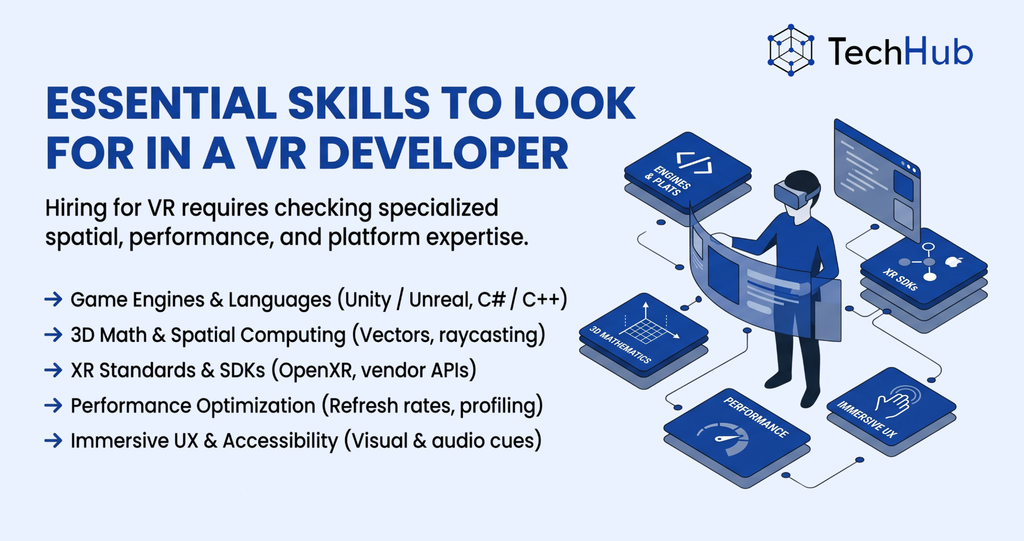
The right skill set depends on the headset, engine, visual requirements, and whether the experience is single-user or networked. Use the following areas to turn a broad VR job description into specific hiring criteria.
3.1. Game Engines and Programming Languages
- Unity and C#: Common choices for standalone headsets, cross-platform applications, mobile VR, training tools, and enterprise products.
- Unreal Engine and C++: Frequently used for high-fidelity graphics, automotive visualization, architecture, PC-tethered VR, and projects that need deeper engine-level control. Although blueprint expertise is useful, candidates should understand when native C++ is necessary for maintainability or performance.
Do not select an engine based on reputation alone. Existing team skills, target hardware, rendering needs, licensing, plugin dependencies, and long-term maintenance should all influence the decision.
3.2. 3D Mathematics and Spatial Computing
VR developers should understand vectors, matrices, transforms, coordinate systems, raycasting, collision detection, and quaternions. These concepts underpin controller interactions, object movement, camera behavior, physics, and spatial audio.
3.3. XR Standards, SDKs, and APIs
Relevant experience may include:
- OpenXR, the royalty-free cross-platform standard maintained by the Khronos Group
- Meta XR SDK
- SteamVR
- Apple visionOS SDK
- WebXR and JavaScript for immersive experiences delivered through compatible browsers
Candidates should be able to explain which layer is cross-platform and which features still depend on vendor-specific extensions.
3.4. Performance Optimization
Performance is a core VR requirement because inconsistent rendering can produce judder, break immersion, and cause user discomfort. Meta’s published guidance states that interactive Quest applications must use an allowed refresh rate—such as 72, 80, 90, 96, 100, or 120 Hz—and should avoid extended periods below the requested rate. The exact target depends on the headset and application, so the developer must profile on the intended hardware rather than relying only on desktop tests.
Look for experience with:
- CPU and GPU profiling
- Draw-call and triangle-count reduction
- Level of detail and occlusion culling
- Texture, shader, lighting, and memory optimization
- Thermal and power constraints on standalone headsets
- Device-based performance testing and regression checks
3.5. Multiplayer and Backend Integration
Multi-user VR applications require additional knowledge of state synchronization, networked physics, latency, authentication, voice, and server architecture. Relevant tools may include Photon, Netcode for GameObjects, platform services, or custom backend APIs.
3.6. Immersive UX and Accessibility
Flat-screen interface patterns do not always translate well to VR. Strong candidates understand spatial hierarchy, readable depth and scale, locomotion comfort, seated and standing modes, input alternatives, onboarding, and how to guide attention through visual and audio cues.
3.7. Communication and Cross-Disciplinary Work
VR developers constantly negotiate tradeoffs with artists, designers, and product stakeholders. They should be able to explain polygon budgets, texture limits, interaction constraints, and performance risks in language the wider team can act on.
4. Which VR Role Do You Need?
Job titles overlap, so define the expected outcomes instead of hiring by title alone.
| Role | Typical Focus | Best Fit |
| VR Developer | General VR application development across devices or industries | A project that needs a versatile VR generalist |
| VR Game Developer | Gameplay systems, AI, physics, level design, and player engagement | Entertainment and gamified experiences |
| VR App Developer | Training, healthcare, visualization, showrooms, and enterprise integrations | Non-gaming business applications |
| AR/VR or XR Developer | VR plus augmented or mixed reality | Products spanning multiple immersive formats |
| VR Engineer | Architecture, engine-level systems, complex physics, and performance | Senior technical ownership or platform work |
| VR Technician | Device setup, fleet management, deployment, and physical troubleshooting | Hardware operations rather than software development |
5. How Much Does It Cost to Hire VR Developers?
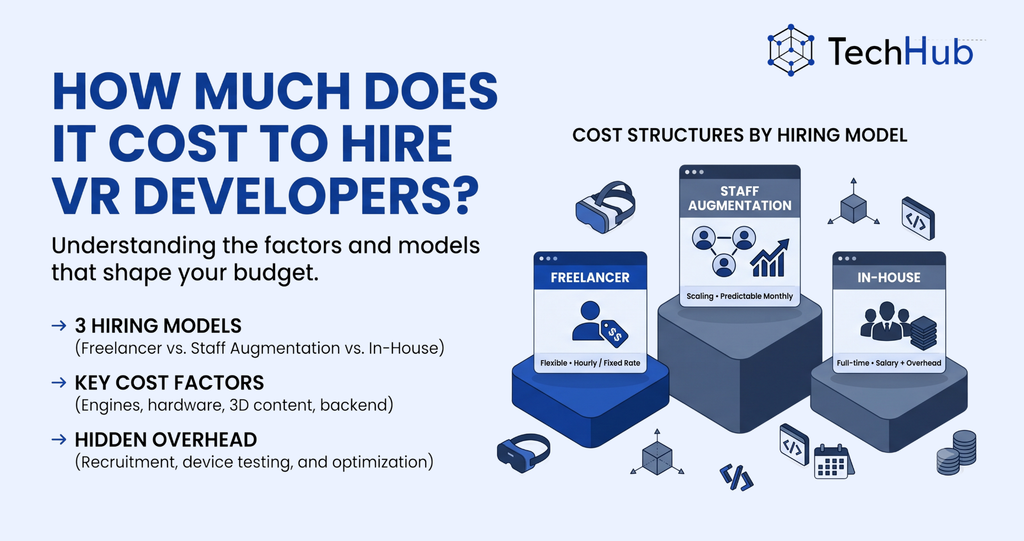
VR developer cost varies by seniority, engine expertise, target hardware, location, engagement model, and the difficulty of the application. Projects that require photorealistic rendering, custom physics, multiplayer synchronization, regulated-industry knowledge, or specialized test hardware usually cost more than a simple single-user prototype.
According to ZipRecruiter’s US salary data, the average annual pay for a VR developer was $109,905 as of 2026. The middle 50% of reported salaries ranged from $84,000 to $134,500. Treat these figures as a US employment benchmark, not a universal project quote; compensation varies by location, experience, and employer.
5.1. Cost Factors to Include in Your Budget
- Engine and language expertise: Senior C++, rendering, and engine-level skills can command a premium.
- Target hardware: Device purchases, test units, peripherals, and access to specialized headsets add cost.
- 3D content: Development estimates may exclude modeling, rigging, animation, audio, and technical art.
- Backend requirements: Accounts, analytics, content management, multiplayer, and integrations expand the scope beyond the headset application.
- Testing and optimization: Performance work on every supported device needs dedicated time and hardware.
- Employment overhead: In-house hiring adds recruitment, payroll, benefits, equipment, management, and retention costs beyond base salary.
Related article: Prices to Charge a Freelance Web Developer: How Much Should You Pay?
5.2. Compare Cost Structures by Hiring Model
| Hiring Model | Typical Cost Structure | Cost Risks | Best For |
| Freelancer | Hourly or fixed-price contract | Scope changes, uneven availability, and extra project management | Prototypes, audits, isolated features, and bug fixes |
| Dedicated developer / staff augmentation | Predictable monthly or hourly rate through a provider | Provider margin and an initial integration period | Long-term delivery, rapid scaling, and embedded collaboration |
| In-house employee | Salary plus recruitment and employment overhead | Longer hiring commitment and higher fixed costs | Permanent capability, core IP, and long-term product ownership |
Before comparing quotes, confirm whether they include project management, QA, 3D assets, hardware, payroll, compliance, replacement support, and post-launch maintenance. A lower developer rate is not necessarily a lower total project cost.
6. Where Can You Hire VR Developers?
The best sourcing channel depends on how quickly you need to hire, how long the work will last, and how much technical vetting your team can perform internally.
6.1. Direct In-House Hiring
Use LinkedIn, specialist game and XR job boards, referrals, or recruitment agencies to build a permanent internal team.
- Advantages: Strong organizational alignment, direct management, and long-term knowledge retention.
- Limitations: Recruitment, compensation, hardware, compliance, and retention remain your responsibility.
6.2. Freelance Platforms
Upwork, Toptal, and similar platforms can provide fast access to independent developers for well-defined tasks.
- Advantages: Flexible contracts and a wide choice of specialists.
- Limitations: Quality and availability vary, and the client normally owns most of the technical vetting and delivery management.
6.3. Developer Communities
GitHub, Unity and Unreal communities, XR events, and specialist forums can help you find developers with visible technical work.
- Advantages: Direct access to practitioners and open-source contributions.
- Limitations: Sourcing is time-intensive, and active community members may not be available for hire.
6.4. Staff Augmentation and Technology Partners
A specialist partner can source, screen, employ, and support developers who work within your process. This model is useful when you need to scale without creating a local legal entity or building an international recruitment operation.
- Advantages: Pre-screened candidates, faster deployment, flexible team size, and support for payroll and compliance.
- Limitations: The developer still needs structured onboarding into your product, tools, communication routines, and engineering standards.
7. Freelance vs. Dedicated vs. In-House VR Developers
| Feature | Freelance VR Developer | Dedicated VR Developer | In-House Employee |
| Commitment | Part-time or project-based | Full-time and assigned to your team | Full-time and permanent |
| Budget Model | Hourly or fixed-price | Predictable monthly or hourly rate | Salary plus employment overhead |
| Availability | May serve multiple clients | Dedicated to the agreed engagement | Dedicated to the employer |
| Team Integration | Usually limited | Works in your tools and routines | Highest long-term integration |
| Best For | Prototypes, audits, and narrow fixes | Core delivery, long projects, and rapid scaling | Permanent capability and strategic IP |
The verdict: If you need a quick prototype or a specific bug fixed, hire a freelance VR developer. If you are building a complex enterprise application and need reliable, long-term talent without the overhead of local hiring, a dedicated VR developer through staff augmentation is often the most efficient choice. Build in-house when the role is permanent and the knowledge must remain deeply embedded in the organization.
Read more: How to Hire Dedicated Developers: A Comprehensive Guide in 2026
8. How to Evaluate VR Developers: Step-by-Step
VR hiring should test what a candidate can build and optimize, not only whether they can solve general coding exercises.
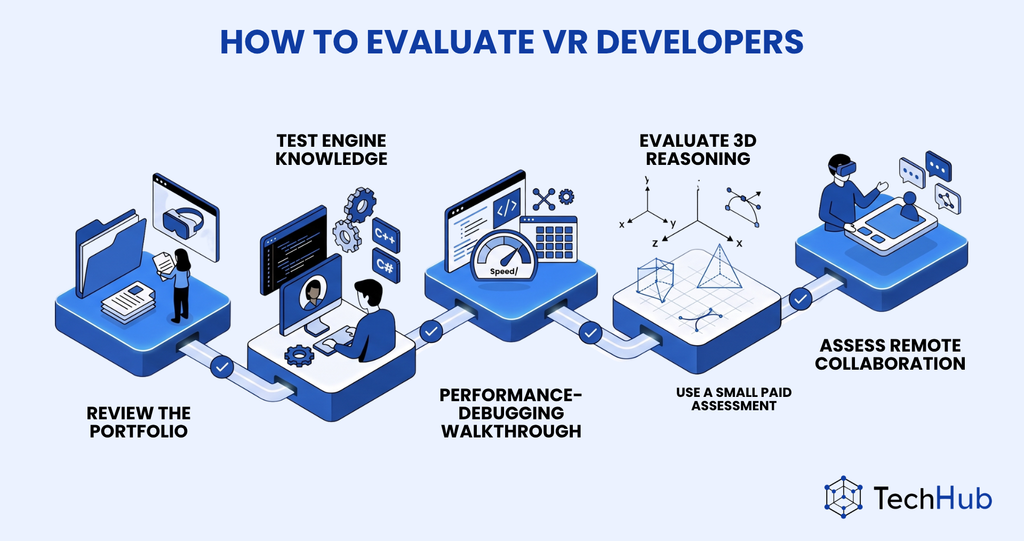
8.1. Review the Portfolio and Establish Ownership
Ask for videos, store links, case studies, or executable builds. For each project, ask:
- What did you personally design or code?
- Which headset and engine did the project use?
- What was the target refresh rate, and how did you verify it?
- Which performance problem was hardest to solve?
- How did you test comfort and interaction quality?
8.2. Test Engine Knowledge in Context
For Unity, ask about Prefabs, ScriptableObjects, coroutines, rendering pipelines, profiling, and XR packages. For Unreal Engine, ask about Blueprint architecture, C++ boundaries, rendering, memory management, and garbage collection. Questions should reflect your actual codebase rather than trivia.
8.3. Ask for a Performance-Debugging Walkthrough
Use a scenario such as: “The application meets its target frame rate in a simple scene but drops during a multi-user interaction on the target headset. How would you isolate the cause?”
A strong answer should describe measurement before optimization and distinguish possible CPU, GPU, memory, rendering, network, and content bottlenecks.
8.4. Evaluate 3D Reasoning
Give the candidate a practical interaction problem. For example: “How would you detect whether a controller is close enough and correctly oriented to grab an object?” A good answer may involve transforms, vectors, distance, angles, colliders, raycasts, interaction states, and feedback—not just one formula.
8.5. Use a Small Paid Assessment
Ask the candidate to build or improve a compact scene using the same engine and target device as the project. Define the time limit and evaluation criteria in advance. Review code structure, performance data, interaction quality, documentation, and the candidate’s explanation of tradeoffs.
8.6. Assess Remote Collaboration
Ask the candidate to explain a technical compromise to a product manager, provide a sample implementation note, or walk through how they would report a blocker. Clear asynchronous communication matters as much as spoken English on distributed teams.
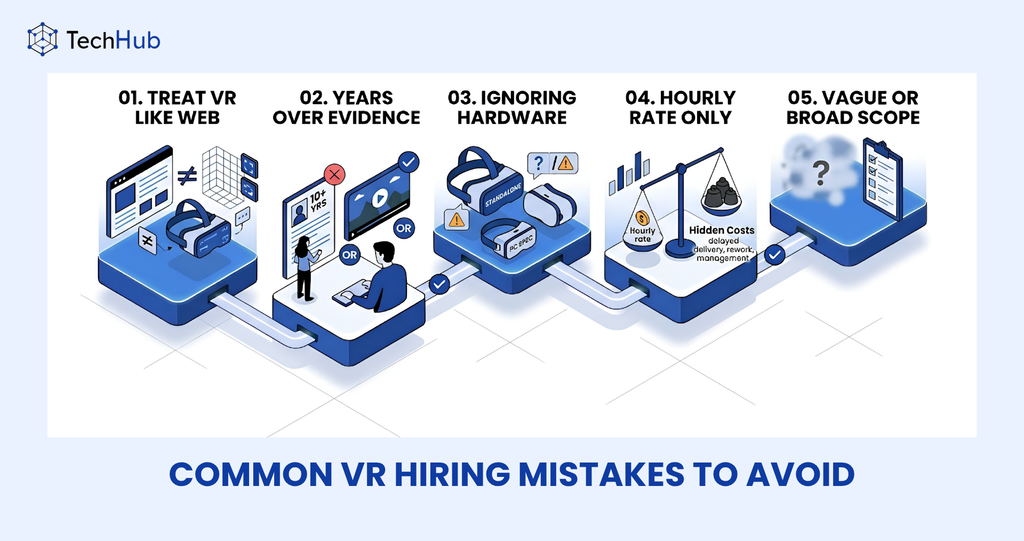
9. Common VR Hiring Mistakes to Avoid
9.1. Treating VR Development Like Web Development
General software experience is valuable, but real-time 3D rendering, spatial interaction, device constraints, and comfort requirements require specialized practice. Do not assume that an otherwise strong developer can immediately own a production VR application without relevant experience.
9.2. Hiring for Years Instead of Evidence
VR tools evolve quickly, and years of general experience do not prove current engine or device competence. Give more weight to shipped work, technical ownership, performance evidence, and the candidate’s reasoning.
9.3. Ignoring the Target Hardware
A PC-tethered headset and a standalone headset have different processing, thermal, memory, and deployment constraints. Specify supported devices before hiring and test candidates against those requirements.
9.4. Selecting on Hourly Rate Alone
Low rates can be offset by slower delivery, weak optimization, rework, and project-management overhead. Compare candidates on total expected delivery cost, not only the price of one development hour.
9.5. Leaving the Scope Too Broad
Define the first release, target devices, engine, user modes, content pipeline, integrations, networking, analytics, and acceptance criteria before interviews. Better scope produces better candidate matching and more comparable estimates.
10. How TechHub Asia Helps You Hire Pre-Vetted VR Developers
TechHub employs more than 200 engineers, maintains a network of over 30,000 screened candidates in Vietnam, has delivered 300+ projects in 12 countries, and reports a 90% client satisfaction rate.
For VR requirements, TechHub can screen candidates against the engine, programming language, target headset, 3D mathematics, optimization, networking, and communication requirements defined for the role. Its VR development capabilities cover consulting, architecture, 3D content, software development, integration, QA, and ongoing support.
A Structured Screening Process
TechHub states that every directly employed engineer passes a five-step screen before a client receives a profile. For a VR role, the evaluation should be tailored to the actual device and codebase, with portfolio ownership, engine proficiency, profiling, and spatial reasoning verified explicitly.
Fast, Supported Onboarding
TechHub’s staffing process covers candidate selection, contracts, payroll, tax, benefits, and ongoing reporting. Its service page states that selected technology talent can join a client team within seven days, subject to role requirements and candidate availability.
Flexible Team Models
Clients can add one developer to an existing team or assemble a wider delivery group that includes VR developers, technical artists, backend engineers, QA specialists, and project leadership. The developers work within the client’s tools, sprint routines, and technical standards while TechHub manages local employment operations.
11. Conclusion
The most efficient way to hire VR developers is to make the role specific before starting the search. Define the headset, engine, first release, performance target, networking requirements, and team structure; then evaluate candidates through relevant portfolio evidence, profiling knowledge, and a small practical task.
Use freelancers for narrow, short-term work, dedicated developers for sustained product delivery, and in-house hiring for permanent strategic capability. Whichever model you choose, prioritize device-tested performance, spatial interaction quality, clear technical ownership, and the ability to collaborate across engineering, art, and product teams.

