

Quick answer
To hire Kotlin developers efficiently, first define whether the role is for Android, backend, or Kotlin Multiplatform work; then assess candidates on the frameworks and architecture used in that domain, not on Kotlin syntax alone. A 2026 European rate guide puts Western European contractor rates around $64–$108 per hour and Central and Eastern European contractor rates around $45–$70 per hour, while our report shows a $12–$40 hourly range for senior-led offshore teams. These figures are planning references for software developers generally—not guaranteed Kotlin quotes—so request a role-specific rate that states seniority, engagement model, and what the fee includes.
Kotlin, developed by JetBrains, is used for Android applications, backend services, and cross-platform products. The difficult part is rarely deciding whether the language can support the product; it is matching the role to an engineer who understands the relevant ecosystem, architecture, testing practices, and delivery constraints.
This guide gives technology decision-makers a practical framework to define the role, compare hiring models and costs, evaluate candidates, and create a defensible Kotlin hiring process.
- 1. What Does a Kotlin Developer Do
- 2. The Seniority Matrix
- 3. Why Businesses Hire Kotlin Developers
- 4. Skills to Look for in a Kotlin Developer
- 5. Kotlin Developer Job Description Template
- 6. How Much Does It Cost to Hire Kotlin Developers
- 7. Where Can You Hire Kotlin Developers
- 8. Freelance vs. Dedicated Kotlin Developers
- 9. How to Evaluate Kotlin Developers
- 10. Common Hiring Mistakes to Avoid
- 11. How to Hire Pre-Vetted Kotlin Developers
- 12. How TechHub Asia Helps Your Business To Hire Kotlin Developers
- 13. Conclusion
- 14. FAQs
1. What Does a Kotlin Developer Do
A Kotlin developer designs, writes, tests, and maintains software using the Kotlin programming language. Depending on the product, that can mean native Android development, server-side applications, or cross-platform code shared through Kotlin Multiplatform. Google’s Android Kotlin guidance and JetBrains’ Kotlin documentation are the primary references for the language and its supported ecosystems.
While Kotlin is statically typed and interoperable with Java, a developer’s day-to-day responsibilities depend heavily on their domain focus:
1.1. Android development
Android-focused Kotlin developers migrate or maintain Java codebases, build interfaces with Jetpack Compose, manage state and local data, integrate APIs, and test application behavior across devices and lifecycle events.
1.2. Backend development
Backend Kotlin developers use frameworks such as Spring Boot, Ktor, or Quarkus to build APIs, services, and microservice-based systems. They should understand asynchronous programming, observability, database access, security, testing, and deployment—not only language syntax. JetBrains maintains an official overview of backend development with Kotlin.
1.3. Kotlin Multiplatform (KMP) development
KMP engineers share selected business logic, networking, and data layers across platforms while retaining platform-specific code where needed. They must understand Gradle, source sets, platform APIs, and native constraints. Unlike Flutter or React Native, KMP can be adopted selectively rather than requiring every layer of the product to use one shared UI approach. See JetBrains’ Kotlin Multiplatform overview.
Read more: Android Developer Career Outlook 2025: Trends, Salaries & Hiring Demand
2. The Seniority Matrix
To hire the right talent, you must align project complexity with the correct seniority level:
- Junior Kotlin Developer: Focuses on bug fixes, writing unit tests, and implementing UI components under strict supervision. They understand basic Kotlin syntax and null safety but lack architectural foresight.
- Mid-Level Kotlin Developer: Independently develops major features, integrates complex third-party APIs, and understands local data caching. They write clean, idiomatic Kotlin code and actively participate in code reviews.
- Senior Kotlin Developer: Designs application architecture, sets CI/CD pipelines, optimizes memory usage, and mentors junior engineers. They dictate how the application scales and make high-level decisions regarding modularization and state management.
- Kotlin Architect: Aligns the technology stack with business objectives. They evaluate the Total Cost of Ownership (TCO) for different frameworks, manage large-scale migrations from Java, and ensure cross-team code consistency.
3. Why Businesses Hire Kotlin Developers
Businesses typically adopt Kotlin to modernize an existing JVM or Android codebase, improve developer ergonomics, build server-side services, or share selected logic across platforms. The value depends on the architecture and implementation quality; Kotlin alone does not guarantee faster delivery or lower costs.
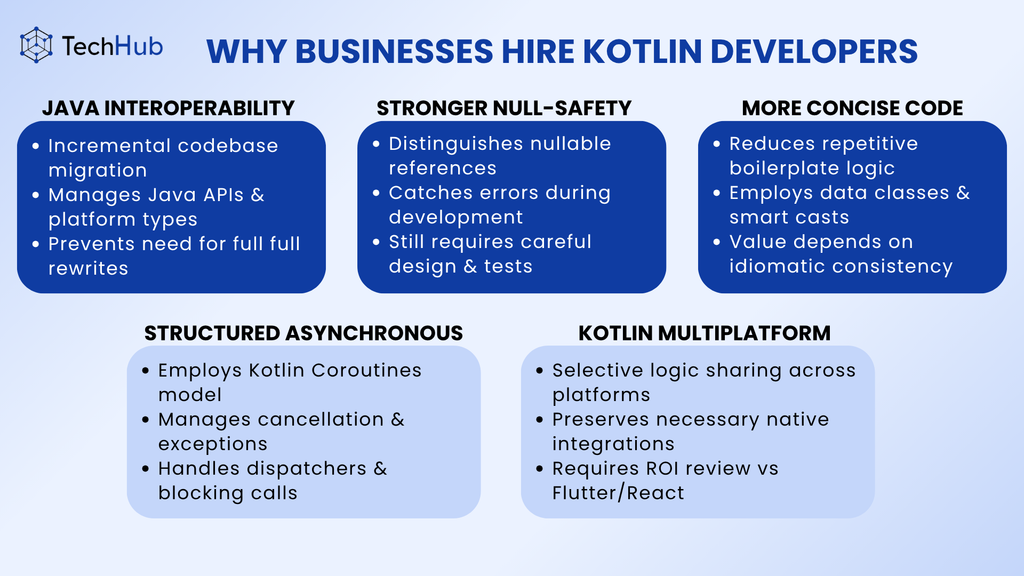
3.1. Java interoperability
Kotlin is designed to work with Java code, which allows teams to migrate incrementally rather than rewrite an entire JVM codebase at once. A qualified developer should still be able to identify interoperability issues, platform types, build-system constraints, and Java APIs that do not translate cleanly (The mechanics are provided by Java interoperability guide).
3.2. Stronger null-safety controls
Kotlin distinguishes nullable and non-nullable references in its type system, helping developers catch many null-related errors during development. This reduces one common source of defects, but it does not make an application automatically crash-free: Java interoperability, explicit assertions, initialization errors, and other runtime failures still require careful design and testing (Kotlin null-safety documentation).
3.3. More concise application code
Features such as data classes, extension functions, smart casts, and higher-order functions can reduce repetitive code. The practical gain depends on whether the team writes idiomatic Kotlin and maintains consistent conventions; concise code that is unfamiliar to the team can be harder, not easier, to maintain.
3.4. Structured asynchronous programming
Kotlin coroutines provide a structured model for asynchronous work. For backend hiring, test whether candidates understand cancellation, exception propagation, dispatchers, blocking calls, and performance measurement rather than accepting “uses coroutines” as proof of scalability. See the official coroutines overview.
3.5. Selective code sharing with Kotlin Multiplatform
KMP can reduce duplicated implementation and maintenance by sharing suitable logic across platforms while preserving native integrations. The actual return depends on the shareable scope, team experience, build complexity, and testing strategy; it should be evaluated against native development, Flutter, or React Native for the specific product.
Related article: Hire Remote Software Developers in Vietnam: the Best Step-by-Step Guide
4. Skills to Look for in a Kotlin Developer
Evaluating candidates requires looking past the language syntax. A strong Kotlin developer for hire must possess a combination of core language mastery, domain-specific framework knowledge, and rigorous engineering fundamentals.
Use the following self-contained checklist to structure technical screening.
| Skill area | What to verify | Why it matters |
| Kotlin type system | Nullable vs. non-nullable types, smart casts, sealed classes, generics, and safe handling of Java platform types | Reveals whether the candidate writes idiomatic, defensive Kotlin rather than Java-style code with Kotlin syntax |
| Coroutines and Flow | Structured concurrency, cancellation, dispatchers, exception handling, StateFlow/SharedFlow, and blocking-call detection | Prevents lifecycle bugs, stalled threads, and unreliable asynchronous behavior |
| Android | Android SDK, Jetpack Compose, ViewModel, StateFlow, Room, lifecycle management, testing, and Hilt/Dagger | Required for maintainable native Android applications |
| Backend | Spring Boot or Ktor, API design, security, persistence, observability, testing, containers, and cloud deployment | Required for production server-side systems; Android experience alone is not sufficient |
| Kotlin Multiplatform | Source sets, Gradle configuration, expect/actual declarations, shared-module boundaries, and native integrations | Shows whether the candidate can choose what to share without creating cross-platform build debt |
| Testing | Unit, integration, and UI tests using appropriate tools such as JUnit, MockK, and Espresso | Demonstrates whether the engineer can ship changes safely and diagnose regressions |
| Architecture | Evidence of trade-off decisions involving MVVM, MVI, Clean Architecture, modularization, or backend patterns | Separates framework familiarity from system-design ability |
| Delivery practices | Git, code review, CI/CD, release processes, monitoring, and incident response | Determines whether the engineer can work within a professional delivery lifecycle |
| Communication | Clear written updates, explanation of trade-offs, early escalation of blockers, and workable English for international teams | Reduces coordination risk in distributed teams |
5. Kotlin Developer Job Description Template
Use this short template as a starting point, then remove any requirement that is not relevant to the actual project:
Kotlin Developer Job Description
Role: [Android / Backend / Kotlin Multiplatform] Kotlin Developer
Objective: Build and maintain [PRODUCT OR SYSTEM] for [USER OR BUSINESS CONTEXT].
Core responsibilities: Design and implement Kotlin features; write and maintain automated tests; review code; document technical decisions; investigate defects; and collaborate with product, QA, and engineering stakeholders.
Required stack: [KOTLIN VERSION], [ANDROID + COMPOSE / SPRING BOOT / KTOR / KMP], [DATABASE], [CLOUD], [CI/CD].
Evidence requested: One relevant production system, a code sample or practical review exercise, and an explanation of one architecture trade-off.
Working model: [TIME ZONE OVERLAP], [FULL-TIME OR PART-TIME], [CONTRACT LENGTH], [SECURITY OR COMPLIANCE REQUIREMENTS].
6. How Much Does It Cost to Hire Kotlin Developers
The cost of hiring Kotlin developers varies by location, hiring model, seniority, specialization, and scope. When budgeting, compare the total engagement cost rather than a salary or hourly figure in isolation.
Different cost bases are shown below. The U.S. figure is a direct salary benchmark, the European figures are contractor ranges, and the Vietnam figure is one provider’s published vendor rate. They are included to establish a planning range, not to imply an apples-to-apples comparison.
2026 Benchmarks by Market
| Region | Benchmark | Source |
| United States | $135,980 annual median wage | U.S. Bureau of Labor Statistics |
| Western Europe | $64–$108/hr | Index.dev 2026 European rate guide |
| Central and Eastern Europe | $45–$70/hr | Index.dev 2026 European rate guide |
| Vietnam | Start from $12/hour at mid-level and rise with seniority | Techhub Asia updated Vietnam Kotlin developer rate |
About this table:
- Salary, independent-contractor, and vendor billing figures are different cost bases and should not be compared as if they were identical.
- A vendor rate may include recruitment, employment administration, equipment, bench risk, replacement support, and account management; a salary does not.
- Kotlin specialization, seniority, security requirements, engagement length, and time-zone overlap can move a quote materially.
The Accelerance 2026 Global Software Outsourcing Rates and Trends Guide draws on data from more than 100 firms across North America, Latin America, Europe, and Asia and is a useful additional reference for regional budgeting. A final hiring decision should still use a written, role-specific quote.
When Vietnam Is a Practical Option
Vietnam may be a practical sourcing market when a company wants an offshore team, can manage time-zone differences, and values lower published vendor rates than many Western contractor markets.
Cost should not be treated as proof of delivery quality. Compare candidates and vendors on Kotlin specialization, English communication, security controls, retention, code-review practices, replacement terms, and the total management effort required from the client.
Read more: Recruiting Tech Talents in Vietnam: A Strategic Guide for 2026
7. Where Can You Hire Kotlin Developers
Selecting the right sourcing channel depends entirely on your product timeline, budget, and internal management capacity.
| Recruitment Method | Best For | Advantages | Limitations |
| In-House Recruitment | Core product companies building their long-term, foundational IP. | Direct employment relationship, stronger long-term product context, and greater control over team structure. | The company owns sourcing, assessment, employment costs, equipment, onboarding, and retention. Time-to-hire varies by market and role scarcity. |
| IT Staff Augmentation / Outsourcing Partners | Companies that need dedicated capacity for a defined period or a skill that is difficult to hire locally. | A provider can handle sourcing and employment administration and may present screened profiles faster than a new internal search. | Requires clear communication channels and strong internal product management to align external developers with business goals. |
| Freelance Marketplaces (Upwork, Toptal) | Short-term, isolated projects or bug fixes. | A broad global pool and flexible engagement terms. | Availability, continuity, security processes, and quality vary by individual, so the client must perform careful due diligence and management. |
| Local Recruitment Agencies | Traditional enterprises that require on-site presence. | Reduces the internal effort required for candidate sourcing and initial screening. | Placement fees and replacement terms vary, and a local-only search may restrict the available talent pool. |
8. Freelance vs. Dedicated Kotlin Developers
When companies look outside their direct payroll, the choice usually narrows down to hiring freelancers versus engaging a dedicated development team through an IT partner. Understanding this distinction is critical for risk management.
| Factor | Freelance Kotlin Developer | Dedicated Kotlin Developer (Staff Augmentation) |
| Commitment | May work with more than one client unless exclusivity is agreed. | Can be allocated full-time when the contract explicitly requires it. |
| Continuity | Depends on the individual contract and availability. | A provider may offer replacement support; verify the actual clause and timeline. |
| Security & IP | Requires an individual NDA, access controls, and clear IP assignment. | Can add company-level controls and agreements, but these must be verified during vendor review. |
| Management Effort | The client directly manages scope, availability, and delivery. | The client still manages product direction; delivery support varies by provider and engagement. |
| Best Use Case | Small scripts, temporary UI fixes, minor feature additions. | Core application development, long-term maintenance, enterprise integrations. |
For a commercial product, choose based on the duration and sensitivity of the work. A freelancer may fit a bounded task; a dedicated model is usually easier to govern when the engineer will work on core systems over a longer period.
Read more: How to Hire Dedicated Developers: A Comprehensive Guide in 2026
9. How to Evaluate Kotlin Developers
An inefficient hiring process yields poor technical talent. Relying solely on automated coding tests filters out good developers who perform poorly under artificial pressure, while relying only on conversational interviews allows smooth talkers to mask technical deficiencies.
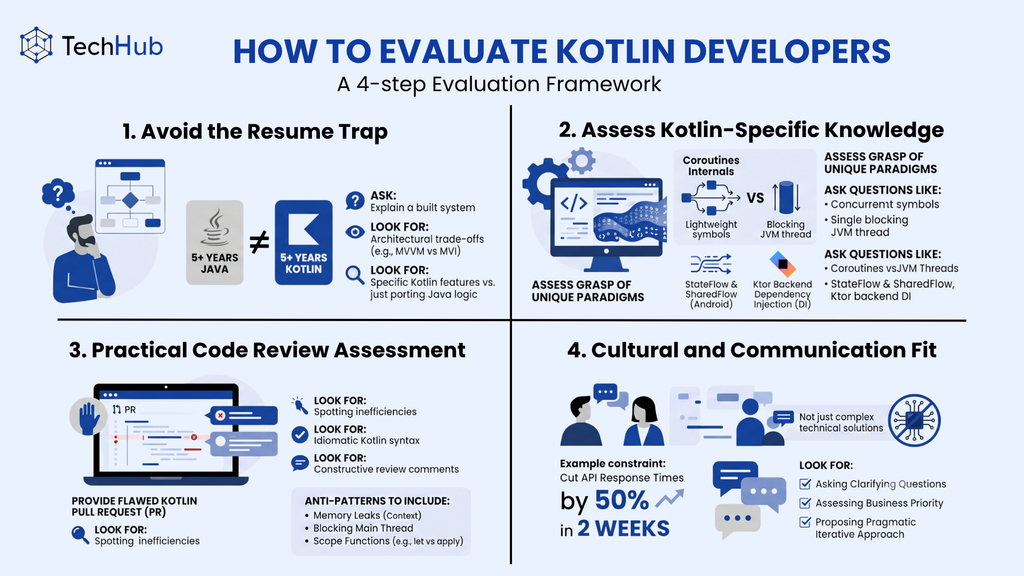
Implement this structured, four-step evaluation framework to identify true Kotlin experts.
9.1. The Architectural Screen (Avoid the Resume Trap)
Do not assume that 5 years of Java experience equals 5 years of Kotlin expertise. During the initial technical screen, ask the candidate to explain a system they built.
⇒ What to look for: Do they understand the trade-offs of the architecture they chose (e.g., MVVM vs MVI)? Can they explain why they used specific Kotlin features to solve a problem rather than just porting Java logic?
9.2. The Kotlin-Specific Deep Dive
Assess their grasp of Kotlin’s unique paradigms.
⇒ Key questions: Ask them to explain the internal mechanics of Coroutines versus traditional JVM threads. Have them describe how they handle StateFlow and SharedFlow in Android, or how they manage dependency injection in a Ktor backend application.
9.3. Practical Code Review Assessment
Instead of forcing candidates to reverse a binary tree on a whiteboard, provide them with a pull request containing flawed Kotlin code. The code should include common anti-patterns (e.g., memory leaks with context in Android, blocking the main thread, or improper use of scope functions like let vs apply).
⇒ What to look for: Their ability to spot inefficiencies, their understanding of idiomatic Kotlin syntax, and how constructively they leave review comments.
9.4. Cultural and Communication Fit
Give the candidate a hypothetical business constraint (e.g., “We need to cut API response times by 50% but only have two weeks”).
⇒ What to look for: A strong developer will not just suggest the most complex technical solution. They will ask clarifying questions, assess the business priority, and propose a pragmatic, iterative approach.
10. Common Hiring Mistakes to Avoid
Even experienced engineering managers make systemic errors when attempting to hire Kotlin programmers. Avoid these common pitfalls to protect your budget and timeline.

- Treating Kotlin and Android as Synonymous: Kotlin is the preferred language for Android, but Android development requires deep knowledge of the SDK, lifecycles, and UI components. Do not hire a backend Kotlin developer to build your Android app unless they have proven mobile experience.
- Ignoring Java Legacy Skills: If your project involves migrating an existing application, the developer must be proficient in Java. A developer who only knows Kotlin will struggle to interpret and safely refactor legacy Java modules.
- Over-Indexing on Hourly Rates: Choosing the lowest rate without assessing delivery quality can create rework and management costs that outweigh the initial saving.
- Skipping the System Design Interview: Many developers can write a perfectly functioning screen or endpoint. Far fewer know how to design an application that remains maintainable as the codebase scales to hundreds of thousands of lines.
- Failing to Verify English and Collaboration Skills: If you hire remote Kotlin developers, technical brilliance cannot overcome a communication barrier. If developers cannot clearly articulate blockers during a daily stand-up, the project will stall.
11. How to Hire Pre-Vetted Kotlin Developers
“Pre-vetted” should describe a documented process, not serve as a marketing label. Before selecting a talent partner, ask to see the screening stages, evaluation criteria, sample candidate profile, security terms, replacement policy, and who is accountable after onboarding.
A Verifiable Partner-Screening Checklist
1. Role calibration: Confirm the product domain, Kotlin stack, seniority, working hours, contract length, and security requirements.
2. Evidence-based shortlist: Require profiles to show relevant production work, not only a skills list.
3. Technical verification: Review how the provider assesses Kotlin fundamentals, domain frameworks, architecture, testing, and code-review ability.
4. Client interview: Retain the right to interview the candidate and use a role-relevant practical exercise.
5. Written engagement terms: Confirm allocation, start date, rate inclusions, IP ownership, confidentiality, equipment, leave coverage, and replacement terms.
6. Onboarding and review: Agree on access, success measures, feedback cadence, and the first 30-day review before work begins.
12. How TechHub Asia Helps Your Business To Hire Kotlin Developers
TechHub Asia provides for companies seeking Kotlin developers based in Vietnam. Clients first specify the product domain—Android, backend, or Kotlin Multiplatform—together with the required stack, seniority, working-hour overlap, engagement length, and intended start date.
- Screening: Project-history verification, live coding, a system-design interview, an English assessment, and a reliability check. TechHub reports that approximately 3% of applicants pass this company-wide process.
- Kotlin assessment: Candidates are evaluated on Kotlin fundamentals, Coroutines and Flow, Jetpack Compose, Ktor or Spring Boot, Kotlin Multiplatform, and testing.
- Hiring timeline: A shortlist is generally provided within 48 hours, followed by onboarding in approximately seven days. Rare senior specializations may require two to three weeks.
- Working hours: The Hanoi-based team provides full APAC overlap, coverage of European mornings, and partial overlap arrangements for North American teams.
- Engagement terms: Clients interview and select candidates directly. TechHub handles local employment administration, while intellectual property is assigned to the client. A 30-day review and free replacement during the trial period are also stated, although the exact contractual terms should be confirmed before hiring.
13. Conclusion
An efficient Kotlin hiring process begins with a precise domain and stack, continues with role-relevant technical evidence, and ends with written expectations for delivery and collaboration. Compare the total engagement—not only the hourly rate—and choose the hiring model that fits the duration, risk, and strategic importance of the work.
Key Takeaways
– 2026 contractor rates average $64–$108 hourly in Western Europe and $45–$70 in Central and Eastern Europe, compared to $12–$40 for Vietnam offshore teams.
– Effective Kotlin developer hiring requires evaluating domain-specific framework expertise—such as Jetpack Compose for Android or Spring Boot for backend—rather than basic language syntax.
– Technical screening for Kotlin engineers must evaluate unique asynchronous programming paradigms like Coroutines and Flow through practical code reviews instead of automated algorithm tests.
– Migrating existing JVM applications to Kotlin requires engineers with proficient legacy Java skills to safely interpret and refactor older modules without introducing runtime errors.
– IT staff augmentation provides dedicated Kotlin development capacity for enterprise applications, offering stronger continuity and intellectual property controls compared to short-term freelance contracts.

