
A business building its first Android app needs a different developer from one maintaining a large Java codebase or fixing production crashes. The job title alone will not tell candidates what they must own, and a list of tools will not tell you whether they can deliver it.
This guide helps founders, product leaders, and engineering managers define the role, assess Android skills, compare hiring options and costs, and set up a working arrangement that lasts beyond the first release.
Quick answer
To hire Android developers, define your app’s current state, the work they will own, and how independently they must operate. Match their Kotlin and Android experience to your codebase, then assess relevant past work and a short, paid task. Choose an employee, contractor, dedicated remote developer, or development partner based on the ownership required. Compare the full delivery cost, including review, QA, and release work.
- 1. What do Android developers do?
- 2. Which Android Skills Matter?
- 3. Where and How to Hire Android Developers
- 4. How Much Does It Cost to Hire an Android Developer?
- 5. How to Evaluate Android Developers
- 6. Native Android, Kotlin Multiplatform, or Cross-Platform?
- 7. Manage Remote Work and Keep Control of Your App
- 8. Hiring Android Developers in Vietnam and Southeast Asia
- 9. Common Hiring Mistakes
- 10. How to Choose an Android Development Partner
- 11. Conclusion
- 12. FAQs
1. What do Android developers do?
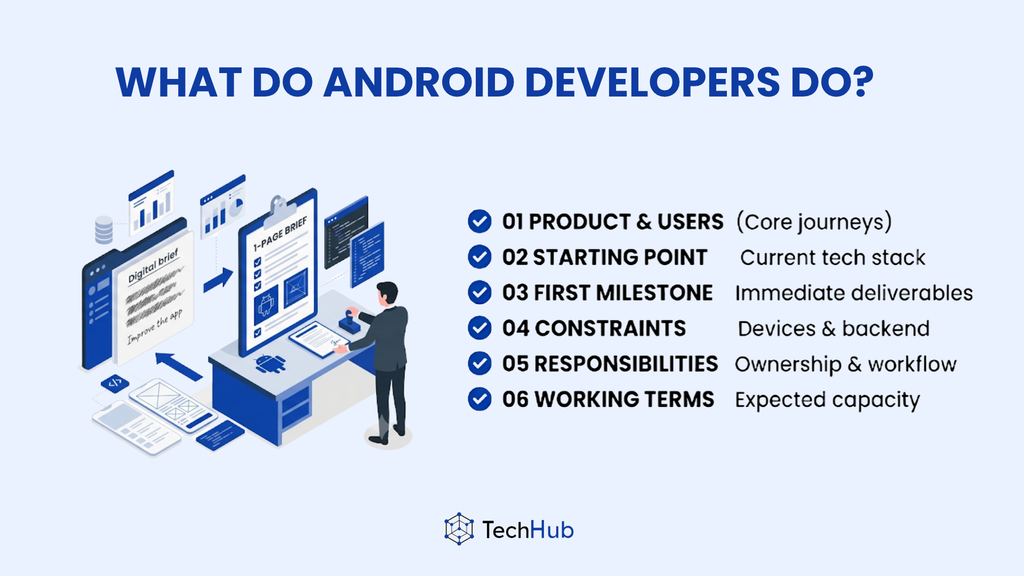
Begin with a one-page brief that tells a candidate what exists, what must change, and who will make decisions. Include:
- Product and users: The app’s purpose and its most important user journeys.
- Starting point: New build or existing app; Kotlin, Java, or both; Compose, Views, or both.
- First milestone: A feature, migration, release, or measurable reliability problem.
- Constraints: Supported devices, backend APIs, third-party SDKs, offline needs, data sensitivity, and hardware integrations.
- Team responsibilities: Who owns design, backend work, QA, architecture, code review, and publication.
- Working terms: Expected capacity, time-zone overlap, contract length, and target start date.
“Improve the app” gives little direction. “Reduce crashes in the checkout flow, add tests for failed payments, and prepare the next release” gives candidates a clear problem to discuss.
Match seniority to ownership
| Level | Appropriate work | Support required |
| Entry-level developer | Scoped features and maintenance in an established codebase | Clear requirements, frequent review, and technical guidance |
| Mid-level developer | Independent feature delivery within an existing architecture | Product priorities and review of larger decisions |
| Senior developer | Architecture, difficult integrations, performance, releases, and mentoring | Clear business goals and authority to make technical decisions |
| Specialist | A defined need such as C/C++ integration, media, payments, accessibility, or device hardware | Access to relevant systems and a precise scope |
If no one on your team can review Android code, an entry-level developer should not be your sole mobile hire. When you hire senior Android developers, look for decisions made and outcomes owned, rather than years of experience alone.
An Android engineer also does not automatically replace a designer, backend engineer, or QA engineer. Identify those dependencies before setting a delivery date.
2. Which Android Skills Matter?
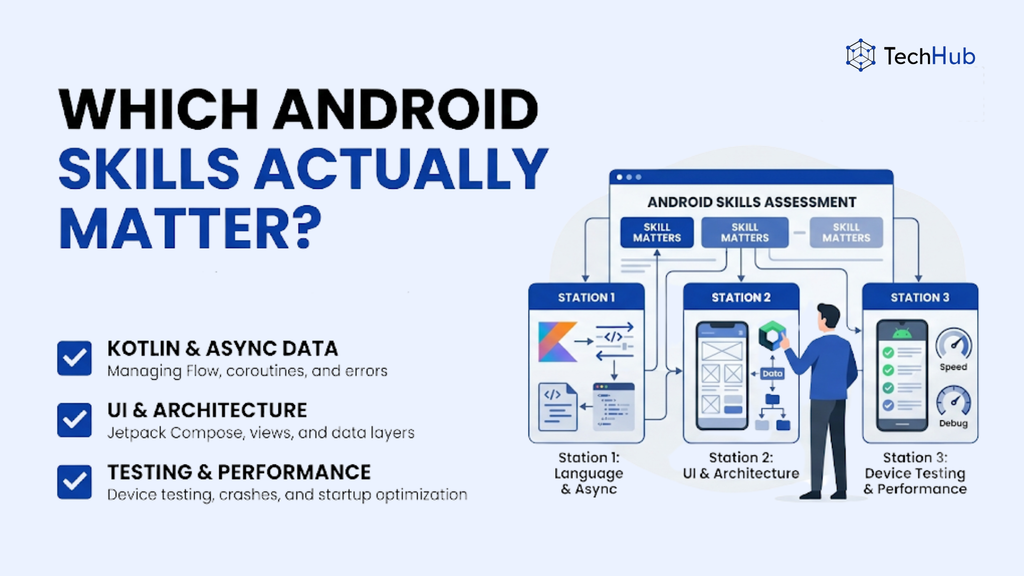
The strongest criteria reflect your app. Android Studio is the development environment; the Android SDK supplies platform APIs and tools; Jetpack is a collection of libraries and UI tools. A candidate should know the tools relevant to your project, but “Android Studio developer” is not a useful specialty by itself.
2.1. Kotlin, Java, and the existing code
For a new native app, Kotlin is a sensible default. Android’s Kotlin-first guidance recommends starting with Kotlin, continues to support Java, and allows both languages in one project. An existing Java app therefore does not need a wholesale rewrite to adopt Kotlin.
For a deeper language-focused assessment, see our guide to hiring Kotlin developers.
Probe beyond syntax. Ask how the developer uses coroutines and Flow for asynchronous data, handles failed network requests, and restores a screen after the app process is interrupted.
2.2. UI, architecture, and integrations
Jetpack Compose is Android’s recommended modern toolkit for native UI. Existing apps may use XML layouts and Views. Android’s Compose-in-Views guidance shows how Compose can be added to a View-based app without replacing every screen at once.
Ask where a candidate would put UI state, data access, and business rules. Android’s architecture recommendations favor distinct UI and data layers. Depending on the app, familiarity with ViewModel, Room, Navigation, WorkManager, and dependency injection may be useful. Require evidence of sound decisions, not every library by name.
Check integrations against the product brief: authentication, API calls, local storage, notifications, payments, or device features. Libraries such as Retrofit or OkHttp and services such as Firebase may be relevant, but a résumé mention matters less than how the developer handles errors, privacy, and maintenance.
2.3. Testing, performance, and specialist skills
Ask what the developer would test locally and what must run on a device or emulator. Android’s testing guidance distinguishes local tests, commonly used for business logic, from instrumented tests that can check integrations and UI behavior. Candidates may use tools such as JUnit and Espresso, but should explain the risks their tests cover.
For a live app, ask about crash diagnosis, startup time, responsiveness, battery use, and device coverage. Android’s technical quality guidance covers production signals such as stability and performance. A developer who owns releases should know how to act on feedback after launch.
Only seek Android NDK expertise when the app needs native C or C++ libraries, intensive processing, or another specific native-code requirement. The NDK guide describes specialist use cases; it is not a standard requirement for every Android role.
3. Where and How to Hire Android Developers
You can recruit employees directly, use referrals or freelance marketplaces, add a dedicated developer to your team, or engage a development partner. Choose based on the work’s duration and how much direction your team can provide.
| Model | Best fit | Main responsibility to settle |
| In-house employee | Android is a continuing core product capability | Recruitment, management, and long-term development |
| Freelance Android app contractor | A bounded task with clear deliverables | Availability, review, and handover |
| Dedicated Android developer or staff augmentation | An ongoing backlog and an existing product or engineering lead | Your team sets priorities and reviews work |
| Outsourced development team | Delivery requires several coordinated roles | Decision rights, quality checks, reporting, and acceptance |
A dedicated developer adds capacity to your process. A managed team may include QA and delivery leadership, but the proposal must say exactly what it includes.
If you are comparing mobile roles more broadly, start with our app developer hub.
4. How Much Does It Cost to Hire an Android Developer?
TechHub Asia’s published starting rates are $12/hour for a mid-level dedicated Android developer, $18/hour for a senior developer, and $26/hour for a tech lead. Clutch reports 25–49/hour for app development companies and 100–149/hour for companies in Australia. These describe different purchases, so compare quotes against the same scope. See TechHub Asia’s Android developer rates and Clutch’s 2026 pricing guide.
| Published reference | Figure | What it describes |
| TechHub Asia: mid-level Android developer | From $12/hour | Advertised starting rate for our dedicated model |
| TechHub Asia: senior Android developer | From $18/hour | Advertised starting rate; confirm against the role brief |
| TechHub Asia: Android tech lead | From $26/hour | Advertised starting rate; confirm responsibilities and allocation |
| Clutch 2026 mobile app pricing guide | $25–49/hour | App development company pricing in Clutch’s data |
| Clutch 2026 Australia listing | $100–149/hour | Listed mobile app development company pricing in Australia |
| TopDev 2024–2025 Vietnam report | $1,020–1,890/month; $1,220 median | Historical gross monthly Android employee salary before tax and excluding benefits; not a client billing rate |
TechHub Asia includes sourcing, vetting, employment administration, payroll, statutory contributions, workspace, and delivery management. The rate for your role depends on seniority, specialist requirements, and engagement terms; ask us for a written quote against your brief.
For U.S. context, the Bureau of Labor Statistics reported a May 2025 median annual wage of $135,980 for software developers. That is a broad occupation figure, not an Android-specific salary or offshore service rate.
Request written quotes against the same brief. Check developer capacity, technical oversight, design, backend work, QA, onboarding, release support, maintenance, minimum commitment, extra-hour terms, IP assignment, and handover.
5. How to Evaluate Android Developers
Use the same questions and scorecard for every serious candidate, whether they come through direct recruitment, a marketplace, or a partner.
5.1. Review their actual contribution
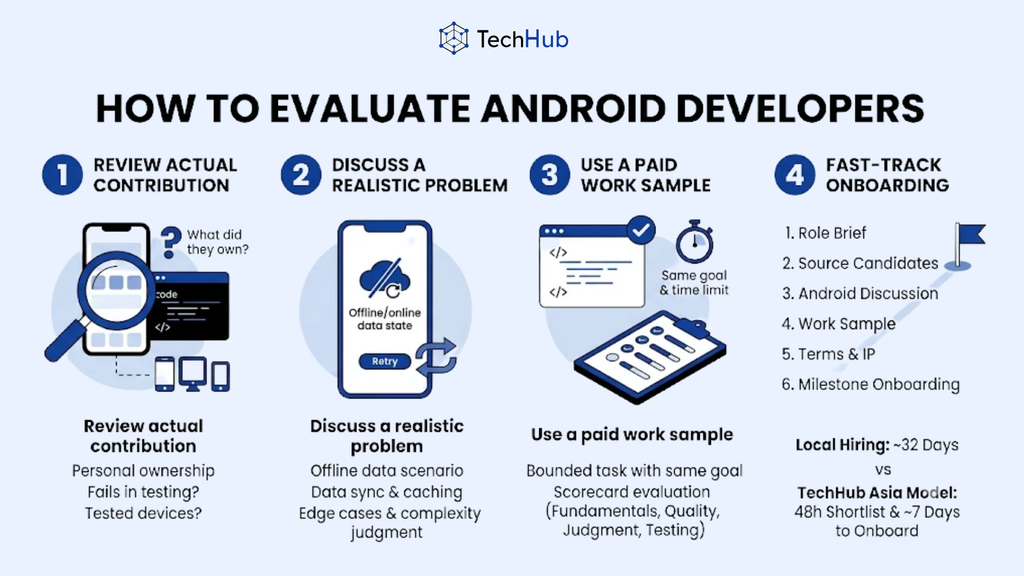
Ask for a shipped app, code sample, or detailed account of relevant work. A store listing does not show what one person built. Ask:
- Which feature or system did you personally own?
- What failed in testing or after release?
- Which devices and Android versions did you test?
- How did you decide what to fix first?
- What would you build differently now?
5.2. Discuss a realistic Android problem
Give the candidate a scenario from your app:
A product list loads from an API. Users must still see useful information when their connection drops, and the screen must restore its state when they return. How would you build and test it?
Listen for loading and error states, a sensible data strategy, lifecycle behavior, and testing choices. Then ask what they would simplify if this were a short-lived prototype. Good judgment includes choosing an appropriate level of complexity.
Other focused interview questions include:
- How would you investigate a crash that appears mainly on lower-cost devices?
- What would you check before introducing Compose into an existing View-based app?
- How would you test a payment flow interrupted after the user leaves your app?
- What evidence would you review before releasing a change to all users?
- How would you plan and test an upgrade to Google Play’s required target API level?
- How would you check code suggested by an AI coding tool before merging it?
5.3. Use a short, paid work sample
A bounded task in a starter project can reveal code organization, error handling, tests, communication, and response to feedback. Give finalists the same goal and time limit. If the work could be used in your product, agree on payment and ownership beforehand.
Score the result against the job, not typing speed:
| Criterion | Evidence to look for |
|---|---|
| Android fundamentals | State, lifecycle, background work, compatibility |
| Code quality | Readable structure and maintainable choices |
| Product judgment | Useful questions and attention to edge cases |
| Testing | Checks aimed at the feature’s main risks |
| Communication | Clear assumptions, updates, and explanation |
| Ownership | Evidence of delivery and fixes after release |
A senior sole hire should score strongly on ownership and architecture.
5.4. Move from brief to onboarding
Keep the hiring process short:
- Agree on the role brief, budget, and interview owners.
- Source candidates and screen relevant work and availability.
- Run the structured Android discussion.
- Assess a paid work sample for finalists where useful.
- Check references and agree on access, IP, payment, and exit terms.
- Onboard against one small production-relevant milestone.
For context, TopDev’s 2024–2025 Vietnam report puts the average time to fill a tech position in Vietnam at 32 days in 2024, down from 51 days in 2022. Its measure runs from the job announcement through screening, interviews, and onboarding, and excludes executive headhunting. It describes local hiring, not a managed developer engagement.
For dedicated Android model, TechHub Asia provides a 48-hour shortlist after agreeing the role profile and about seven days to onboard after selection. A rare senior specialization may take two to three weeks of targeted search. Confirm candidate availability and the proposed start date for your role. See the Android hiring process.
6. Native Android, Kotlin Multiplatform, or Cross-Platform?
Confirm the product approach before hiring solely for native Android. If you already have a native app, deep Android integration, or Android-specific device requirements, a native engineer is a direct fit.
If the same product must run on Android and iOS, compare what can be shared. JetBrains’ Kotlin Multiplatform documentation explains that teams can share business logic while keeping native UI, or share some UI through Compose Multiplatform. Flutter supports multiple platforms from one codebase, while React Native builds Android and iOS apps using React. The right choice depends on existing code, platform features, team skills, and maintenance.
A cross-platform developer may suit a two-platform roadmap. For products with simpler device needs, assess a progressive web app alternative as well. Ask candidates which features would still need platform-specific work.
7. Manage Remote Work and Keep Control of Your App
When hiring remote Android developers, set one product owner for priorities and one technical reviewer for code. Agree on overlap hours for decisions and urgent issues, plus a written way to raise blockers. Our guide to hiring remote developers covers team arrangements beyond mobile.
Make the first milestone small enough to review through your normal process. A fix to one existing flow, with tests and a short explanation, reveals more about collaboration than a week of setup meetings.
Before work begins, agree on repository access, code review, production credentials, documentation, release approvals, IP ownership, and handover. Keep those systems under company control and give each person only the access their work requires.
Who should own the Google Play Console account?
Your business should control the developer account for its app. A company owner or administrator can grant developers access to selected apps and permissions without transferring ownership. Google’s Play Console permissions guidance distinguishes account-level access from access to one app.
Document who prepares builds, uploads them, approves production releases, and monitors the result. With Play App Signing, Google manages the app signing key while your team uses an upload key to submit the app bundle. Keep the upload key secure and document its management for handover.
As of 2026, Google Play requires new phone and tablet apps and updates to target Android 16 (API level 36) or higher. Existing apps need API level 35 or higher to remain available to new users on newer devices. Different requirements apply to Wear OS, TV, Automotive, and XR. Make target-API upgrades part of the maintenance owner’s job, and ask candidates how they plan and test one. Check the target API requirements again before a release.
8. Hiring Android Developers in Vietnam and Southeast Asia
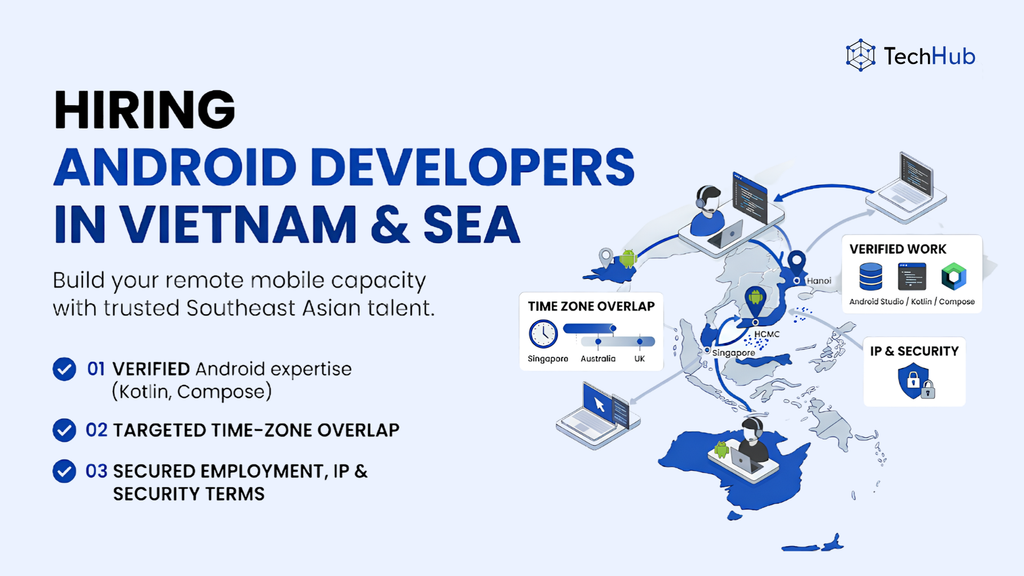
Vietnam can be a practical location for businesses seeking remote Android capacity, but assess the developer and arrangement rather than relying on a country-level assumption. Ask for relevant production work, an interview with the proposed engineer, working-hour overlap, and clear employment, security, and IP terms.
Senior hiring needs more room in the plan than a standard mid-level search. In TopDev’s 2024–2025 Vietnam report, senior developers made up about 18% of the surveyed IT personnel, while leaders and higher levels made up 6%; more than 45% were at fresher or junior level. These are historical market figures, not Android-specific shares, and are consistent with longer searches for senior specialists.
Time zones also shape the working model. A Vietnam-based developer can share much of the workday with Singapore and Australia. A UK team may arrange overlap in its morning; a U.S. team should set specific meeting hours and use written updates for work outside them.
Our Android developer service places Hanoi-based engineers in the client’s repository and processes. We assess candidates across Kotlin, Compose, local data, device behavior, and Play release work; you interview and select the proposed engineer. Request the individual profile and confirm capacity, overlap, rate, and contract terms against your brief.
9. Common Hiring Mistakes
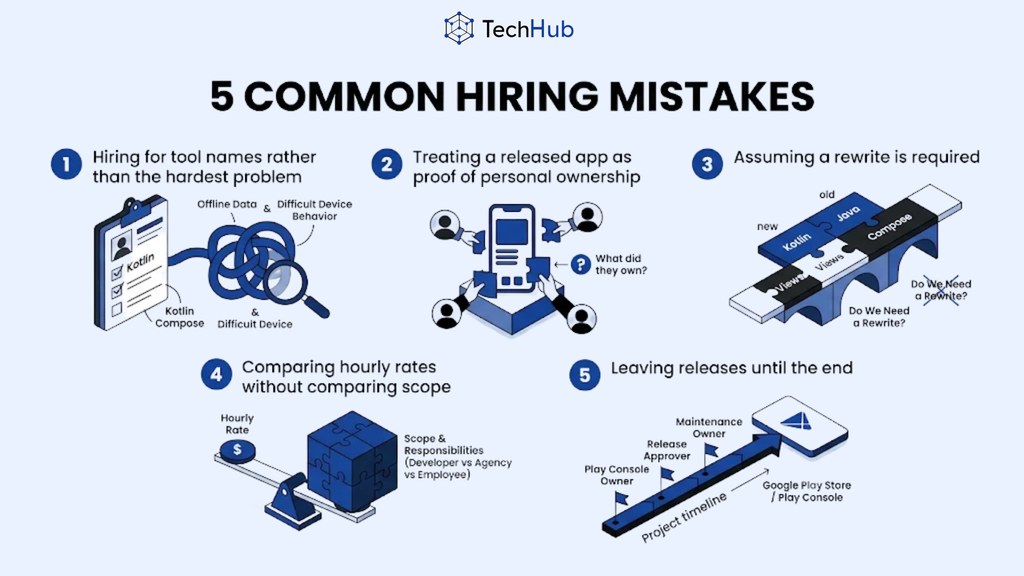
Hiring for tool names rather than the app’s hardest problem. Someone can list Kotlin and Compose without having handled offline data, difficult device behavior, or a production release. Test the relevant problem.
- Treating a released app as proof of personal ownership. Ask which decisions and code the candidate owned, what others built, and what happened after launch.
- Assuming a rewrite is required. Kotlin and Java can coexist, as can Views and Compose. Ask for a feature-by-feature migration case with expected benefits and risks.
- Comparing hourly rates without comparing scope. A developer fee, an agency fee, and an employee salary include different responsibilities.
- Leaving releases until the end. Name the Play Console owner, release approver, and maintenance owner before the first milestone.
10. How to Choose an Android Development Partner
Meet the engineer or delivery lead who would work on your product. Ask the provider to show how the proposed person matches your role brief, how Android ability was checked, and how you can assess the candidate yourself.
Then settle committed capacity, daily priorities, code review, QA, status updates, replacement arrangements, IP assignment, and handover. Request a written quote that identifies what is included and what your team must supply.
If you are considering a Vietnam-based hire, review our dedicated Android developer options. Compare the proposed profile using the same scorecard and scope as your other options.
11. Conclusion
A sound Android hire begins with a clear first milestone and an honest view of who will direct the work. Assess candidates on relevant shipped work, Android-specific decisions, and a small practical task. Compare the complete cost of each model, then agree on access, code ownership, testing, and releases before development starts.
Write the one-page role brief first. If a dedicated Vietnam-based developer fits your plan, request profiles and a role-specific quote to compare with your other options.
Key Takeaways
– Hire for the work ahead. A new Kotlin app, a Java maintenance project, and a performance overhaul need different experience.
– Test Android judgment. Ask how candidates handle interrupted flows, poor connections, device differences, and releases.
– Match the hiring model to your team. A dedicated developer needs product direction and code review; a managed team may provide broader delivery support.
– Read rates in context. Provider fees, agency rates, and employee salaries measure different purchases.
– Keep ownership clear. Your company should control the repository and Google Play Console account, with release and handover terms set before work starts.

